Rich Lederer • Baseball Beat
Patrick Sullivan • Change-Up
Jeremy Greenhouse • Touching Bases
Dave Allen • F/X Visualizations
Sky Andrecheck • Behind the Scoreboard
Marc Hulet • Around the Minors
Al Doyle • Past Times
Retired Uniforms:
Bryan Smith • WTNY
Joe Sheehan • Command Post
Jeff Albert • The Batter's Eye
RSS Feed
Home

*Examining the Past, Present, and Future*
Lineup Card
Recent Entries
» Putting Together a Reality Team
» Historical Hall of Fame Vote Comparisons: 2012
» An All-Christmas Team
» The New-Look Angels
» John Denny: The Forgotten Cy Young Award Winner
» Money Isn't Everything
» What Would It Take to Hit .400 in the 21st Century?
» Halos Heaven
» Brandon McCarthy's Breakout Season
» Link-o-Rama
» Historical Hall of Fame Vote Comparisons: 2012
» An All-Christmas Team
» The New-Look Angels
» John Denny: The Forgotten Cy Young Award Winner
» Money Isn't Everything
» What Would It Take to Hit .400 in the 21st Century?
» Halos Heaven
» Brandon McCarthy's Breakout Season
» Link-o-Rama
Best of Baseball Beat
Abstracts From the Abstracts
1977 Baseball Abstract
1978 Baseball Abstract
1979 Baseball Abstract
1980 Baseball Abstract
1981 Baseball Abstract
1982 Baseball Abstract
1983 Baseball Abstract
1984 Baseball Abstract
1985 Baseball Abstract
1986 Baseball Abstract
1987 Baseball Abstract
1988 Baseball Abstract
1978 Baseball Abstract
1979 Baseball Abstract
1980 Baseball Abstract
1981 Baseball Abstract
1982 Baseball Abstract
1983 Baseball Abstract
1984 Baseball Abstract
1985 Baseball Abstract
1986 Baseball Abstract
1987 Baseball Abstract
1988 Baseball Abstract
Bert Blyleven Series
Meeting Up and Hanging Out with Bert
The Results Are In And...
Aficionado Heavily Invested in Blyleven
Latest on Blyleven's Chances for the HOF
The Internet Zealot Responds
400 Down and 5 to Go...
Bert Be Home By Eleven?
Blyleven's Forgotten Season (1973)
HeyMan, Your Comments Don't Hold Water
The Waiting is the Hardest Part
Another Addition to the Blyleven Series
Search for the Truth
As Dominant as His HOF Contemporaries
Listen, Buster
A Larger Step for Blyleven
Answering the Naysayers (Part Two)
Another Small Step for Blyleven
Q&A: Blyleven on the Twins
The Majority Rules, Right?
It's All Dutch to Some
The Hall of Fame Case for Bert Blyleven
Q&A: Blyleven on Felix Hernandez
Clemens Rocketing Up Charts
Poz: An Interview With a KC Star
A HOF Chat with Tracy Ringolsby
Up Close and Personal
A Peek Into the Mind of a HOF Voter
Answering the Naysayers
It's That Time of the Year (Again)
"If Cooperstown is Calling..."
The Bert Alert
One Small Step for Blyleven...
Only the Lonely
The Results Are In And...
Aficionado Heavily Invested in Blyleven
Latest on Blyleven's Chances for the HOF
The Internet Zealot Responds
400 Down and 5 to Go...
Bert Be Home By Eleven?
Blyleven's Forgotten Season (1973)
HeyMan, Your Comments Don't Hold Water
The Waiting is the Hardest Part
Another Addition to the Blyleven Series
Search for the Truth
As Dominant as His HOF Contemporaries
Listen, Buster
A Larger Step for Blyleven
Answering the Naysayers (Part Two)
Another Small Step for Blyleven
Q&A: Blyleven on the Twins
The Majority Rules, Right?
It's All Dutch to Some
The Hall of Fame Case for Bert Blyleven
Q&A: Blyleven on Felix Hernandez
Clemens Rocketing Up Charts
Poz: An Interview With a KC Star
A HOF Chat with Tracy Ringolsby
Up Close and Personal
A Peek Into the Mind of a HOF Voter
Answering the Naysayers
It's That Time of the Year (Again)
"If Cooperstown is Calling..."
The Bert Alert
One Small Step for Blyleven...
Only the Lonely
Exclusive Interviews
Lee Sinins
Alex Belth
David Pinto
Will Carroll
Mike Carminati
Aaron Gleeman
Joe Sheehan
Jay Jaffe
Jeff Peek
Tracy Ringolsby
Joe Posnanski
Bill James Part I, II, III
Jon Lalonde
Chuck Tiffany
Dayn Perry
Fay Vincent
Nate Silver
Alex Belth
David Pinto
Will Carroll
Mike Carminati
Aaron Gleeman
Joe Sheehan
Jay Jaffe
Jeff Peek
Tracy Ringolsby
Joe Posnanski
Bill James Part I, II, III
Jon Lalonde
Chuck Tiffany
Dayn Perry
Fay Vincent
Nate Silver
Bullpen
Rich Lederer
The Odd Couple (with Alex Belth)
The MostUnder Over Underrated Player in Baseball (with Brian Gunn)
Three Wise Men (roundtable by Alex Belth)
Infrequently Asked Questions (interview with Matt Welch)
Interview (Orioles Think Tank)
Bernie and the Yanks (Bronx Banter)
Hope and Faith: How the LAA Win the World Series (Baseball Prospectus)
NL West (The Soul of Baseball)
Greatest Living Hitter? (Sports Illustrated)
Roundtable: 2008 HOF Ballot (Armchair GM)
The Most
Three Wise Men (roundtable by Alex Belth)
Infrequently Asked Questions (interview with Matt Welch)
Interview (Orioles Think Tank)
Bernie and the Yanks (Bronx Banter)
Hope and Faith: How the LAA Win the World Series (Baseball Prospectus)
NL West (The Soul of Baseball)
Greatest Living Hitter? (Sports Illustrated)
Roundtable: 2008 HOF Ballot (Armchair GM)
Patrick Sullivan
Designated Hitters
David Bromberg (Q&A: John Denny)
Mark Armour (H. Killebrew and Versatility)
Joe Lederer (Soundtrack of a Prospect)
David Bromberg (Clemente's Autograph)
David Bromberg (Woody Fryman)
D. Baumstein (WAR Against Age: Pitchers)
Doug Baumstein (The WAR Against Age)
Doug Baumstein (A Lifetime on the Road)
John Fraser (Pick Six)
Mark Armour (How to Score More Runs?)
Bill Parker (What Opening Day Tells Us)
Stan Opdyke (Pat Rispole)
Chris Jaffe (Evaluating Baseball's Mgrs)
Stan Opdyke (Baseball Radio in NYC, 1953)
A. Nathan (Performance of Baseball Bats)
Michael Weddell (Edgar Martinez/HOF)
Jon Weisman (100 Things Dodgers Fans...)
Stan Opdyke (Connie Mack and Vin Scully)
Eric Walker (Evaluating Run Production)
Brent Mayne (The Intangibles of Catching)
Chris Moore (Best Fastballs in Baseball)
Dave Baldwin (The Batter’s Brain)
Shawn Haviland (Ivy League to MLB)
Larry Granillo (Walking Off)
Rob Iracane (Solo HR Won't Break You)
Tommy Bennett (Charm of AM Radio)
Harry Pavlidis (Johan Santana's Fast Start)
John Walsh (WAR and Remembrance)
Eric Walker (Precisely Inaccurate)
Bob Timmermann (As They See 'Em)
Geoff Young (Unicycles and Delusions)
Baseball Analysis at Tufts (Groundballers)
Baseball Analysis at Tufts (GB Out Rates)
G. Rybarczyk ('09 Hit Tracker Projections)
Joe Lederer (Curt Schilling/HoF)
Conor Gallagher (Hall of Fallacies)
Chris Green (Jim Rice, HoF, the Numbers)
Shawn Hoffman (Baseball's Bear Mkt?)
Paul Anthony (Manny Syndrome)
Ross Roley (World Series Odds)
B. Timmermann (Catcher's Interference)
R.J. Anderson (Waiting the Hardest Part)
Maury Brown (Cubs, MLB, and Cuban...)
Myron Logan (Dee-Fense, Dee-Fense)
Craig Calcaterra (Frivolity, Part I, Part II)
Chad Finn (Ode to Baseball Cards)
David Cameron (Mariners Foibles)
Chris Dial (Chipper Jones)
Pat Lederer (Memory Lane)
David Appelman (Clutch Pitching)
Bob Rittner (DH)
Jonathan Mayo (Roger Clemens)
Lisa Winston (My Son-in-Law...)
Russ McQueen (The Yellow Hammer)
Bob Rittner (I'm OK, You're OK)
Mark Armour (In Defense of the HOF)
Pat Jordan (Friends)
Dan Levitt (Analysis of Terry Ryan)
Doug Baumstein (Trading Econ 101)
Ross Roley (Runner's Reluctance II)
Ross Roley (Runner's Reluctance I)
Mark Armour (No-Longer Lovable Sox)
Bruce Regal (Stealthy and Wise)
Brian Gunn (Roid Monster)
Current/McEvoy (Value of the SB)
John Rickert (Sinister Thefts)
Nate Silver (Sabermetrics)
David Vincent (Home Run Production)
Joe P. Sheehan (Enhanced Gameday II)
Mark Armour (An Ode to Sport)
David Gassko (All-Time Worm Burners)
Joe P. Sheehan (Enhanced Gameday)
John Walsh (When Titans Clash)
Fox/Williams (Quantifying Coaches II)
Fox/Williams (Quantifying Coaches I)
Jacob Luft (Bull Durham Rant)
Chad Finn (Strat-O-Matic)
Lisa Winston (Rotisserie Baseball)
Dave Studeman (Baseball Stats)
Steve Treder (Roger Craig)
Marc Normandin (Jeff Bagwell)
D. Appelman (Expanding Strike Zone)
Jeff Sackmann (Worst MiL Defenders)
Jeff Sackmann (Best MiL Defenders)
Maxwell Kates (Van Lingle Mungo)
David Appelman (Pitch Location)
Kent Bonham (Danny Ray Herrera)
Glenn Stout (Two Baseball Poems)
Bruce Regal (The Challenge Round)
Mark Lamster (Barry & Ty)
Geoff Young (NL West)
Tom Lederer (The Ryan Express)
Brian Erts (Great Leap Forward)
David Pinto (Parity and the N.L.)
Jacob Luft (Fathers and Daughters)
Jamey Newberg (Pete's Sake)
Jeff Albert (A. Jones Swing Analysis)
Jeff Albert (A-Rod Swing Analysis)
Keith Law (Death, Taxes, and Waivers)
Peter Abraham (Tales of Torre Tales)
Larry Borowsky (Let 'er Rip II)
Dan Levitt (Empirical Analysis of Bunting)
Jonah Keri (If I Met Warren Cromartie...)
Bob Klapisch (War Stories)
Bob Timmermann (John F. Kennedy HS)
Kent Bonham (Aluminum Adjustments)
Al Doyle (More Than Superstars)
Ross Roley (Instant Replay)
David Vincent (Barry Bonds Homers)
Chad Finn (Our Favorite Obscurities)
Bill Deane (1979 NL MVP)
Mark Armour (Rise/Fall of Artificial Turf)
Jeff Angus (Wally Moon Camp)
David Berri (Money and Baseball)
Larry Borowsky (Baseball w/o the #s)
Derek Zumsteg (The Irrational Market)
David Regan (Free Agent Contracts)
Peter Schmuck (Steroids and the HOF)
David Appelman (Pitchers, Pitch by Pitch)
Dan Fox (Swinging, Taking, Fouling, Etc)
Patrick Sullivan (Study of NYY CF/BOS LF)
Will Leitch (Baseball Journalism)
Jeff Sullivan (Pitcher Release Points)
Steve Treder ('69-'70 Giants)
Maury Brown (Charlie Finley)
John Brattain (Bob Johnson)
Bob Klapisch (The Case for Bert Blyleven)
Jeff Peek (Pride and Prejudice)
Dayn Perry (Bert and Warren)
Rob Neyer (If Don Sutton Was Great...)
Lisa Winston (Minor League Memories)
Alex Belth (Otis Redding Was Right)
David Cameron (Long Live the King)
Jeff Angus (Baserunning Study)
Bert Blyleven (Baseball Playoffs)
Boyd Nation (Not a Prospect List)
James Click (Batters-Baserunners Study)
Jeff Shaw (Why I Love Baseball)
David Gassko (BIP/BFP Fielding Study)
Jay Jaffe (Milwaukee Sausage Race)
Jamey Newberg (Remember When)
Bob Klapisch (Press Box to the Mound)
Dan Levitt (Predictive Value of BB)
David Vincent (Official Scorer)
Jon Weisman (Rick Monday)
Larry Borowsky (Let 'er Rip)
Will Carroll (Fictional Short Story)
Bob Timmermann (Japanese Baseball)
Cyril Morong (Best Pitching Seasons)
Sean Forman (Monte Carlo Win-Loss)
Brian Gunn (My Little Blue Book)
Joe Lederer (My Dad and Baseball)
Bill Deane (Bob Gibson, 1968)
Mark Armour (1977 Yankees)
Darren Viola (Retrosheet)
David Pinto (RFK)
Dayn Perry (Brave Heart)
Matt Welch (Dave Hansen)
Kevin Kernan (Jack McKeon)
Tom Lederer (Dodgers Road Trip)
Steve Lombardi (Slider)
Studes (Picturing Baseball)
Mike Carminati (Luck of the Drawl)
Eric Neel (Vin Scully)
J.C. Bradbury (Leo Mazzone)
John Sickels (Bill James)
Mark Armour (H. Killebrew and Versatility)
Joe Lederer (Soundtrack of a Prospect)
David Bromberg (Clemente's Autograph)
David Bromberg (Woody Fryman)
D. Baumstein (WAR Against Age: Pitchers)
Doug Baumstein (The WAR Against Age)
Doug Baumstein (A Lifetime on the Road)
John Fraser (Pick Six)
Mark Armour (How to Score More Runs?)
Bill Parker (What Opening Day Tells Us)
Stan Opdyke (Pat Rispole)
Chris Jaffe (Evaluating Baseball's Mgrs)
Stan Opdyke (Baseball Radio in NYC, 1953)
A. Nathan (Performance of Baseball Bats)
Michael Weddell (Edgar Martinez/HOF)
Jon Weisman (100 Things Dodgers Fans...)
Stan Opdyke (Connie Mack and Vin Scully)
Eric Walker (Evaluating Run Production)
Brent Mayne (The Intangibles of Catching)
Chris Moore (Best Fastballs in Baseball)
Dave Baldwin (The Batter’s Brain)
Shawn Haviland (Ivy League to MLB)
Larry Granillo (Walking Off)
Rob Iracane (Solo HR Won't Break You)
Tommy Bennett (Charm of AM Radio)
Harry Pavlidis (Johan Santana's Fast Start)
John Walsh (WAR and Remembrance)
Eric Walker (Precisely Inaccurate)
Bob Timmermann (As They See 'Em)
Geoff Young (Unicycles and Delusions)
Baseball Analysis at Tufts (Groundballers)
Baseball Analysis at Tufts (GB Out Rates)
G. Rybarczyk ('09 Hit Tracker Projections)
Joe Lederer (Curt Schilling/HoF)
Conor Gallagher (Hall of Fallacies)
Chris Green (Jim Rice, HoF, the Numbers)
Shawn Hoffman (Baseball's Bear Mkt?)
Paul Anthony (Manny Syndrome)
Ross Roley (World Series Odds)
B. Timmermann (Catcher's Interference)
R.J. Anderson (Waiting the Hardest Part)
Maury Brown (Cubs, MLB, and Cuban...)
Myron Logan (Dee-Fense, Dee-Fense)
Craig Calcaterra (Frivolity, Part I, Part II)
Chad Finn (Ode to Baseball Cards)
David Cameron (Mariners Foibles)
Chris Dial (Chipper Jones)
Pat Lederer (Memory Lane)
David Appelman (Clutch Pitching)
Bob Rittner (DH)
Jonathan Mayo (Roger Clemens)
Lisa Winston (My Son-in-Law...)
Russ McQueen (The Yellow Hammer)
Bob Rittner (I'm OK, You're OK)
Mark Armour (In Defense of the HOF)
Pat Jordan (Friends)
Dan Levitt (Analysis of Terry Ryan)
Doug Baumstein (Trading Econ 101)
Ross Roley (Runner's Reluctance II)
Ross Roley (Runner's Reluctance I)
Mark Armour (No-Longer Lovable Sox)
Bruce Regal (Stealthy and Wise)
Brian Gunn (Roid Monster)
Current/McEvoy (Value of the SB)
John Rickert (Sinister Thefts)
Nate Silver (Sabermetrics)
David Vincent (Home Run Production)
Joe P. Sheehan (Enhanced Gameday II)
Mark Armour (An Ode to Sport)
David Gassko (All-Time Worm Burners)
Joe P. Sheehan (Enhanced Gameday)
John Walsh (When Titans Clash)
Fox/Williams (Quantifying Coaches II)
Fox/Williams (Quantifying Coaches I)
Jacob Luft (Bull Durham Rant)
Chad Finn (Strat-O-Matic)
Lisa Winston (Rotisserie Baseball)
Dave Studeman (Baseball Stats)
Steve Treder (Roger Craig)
Marc Normandin (Jeff Bagwell)
D. Appelman (Expanding Strike Zone)
Jeff Sackmann (Worst MiL Defenders)
Jeff Sackmann (Best MiL Defenders)
Maxwell Kates (Van Lingle Mungo)
David Appelman (Pitch Location)
Kent Bonham (Danny Ray Herrera)
Glenn Stout (Two Baseball Poems)
Bruce Regal (The Challenge Round)
Mark Lamster (Barry & Ty)
Geoff Young (NL West)
Tom Lederer (The Ryan Express)
Brian Erts (Great Leap Forward)
David Pinto (Parity and the N.L.)
Jacob Luft (Fathers and Daughters)
Jamey Newberg (Pete's Sake)
Jeff Albert (A. Jones Swing Analysis)
Jeff Albert (A-Rod Swing Analysis)
Keith Law (Death, Taxes, and Waivers)
Peter Abraham (Tales of Torre Tales)
Larry Borowsky (Let 'er Rip II)
Dan Levitt (Empirical Analysis of Bunting)
Jonah Keri (If I Met Warren Cromartie...)
Bob Klapisch (War Stories)
Bob Timmermann (John F. Kennedy HS)
Kent Bonham (Aluminum Adjustments)
Al Doyle (More Than Superstars)
Ross Roley (Instant Replay)
David Vincent (Barry Bonds Homers)
Chad Finn (Our Favorite Obscurities)
Bill Deane (1979 NL MVP)
Mark Armour (Rise/Fall of Artificial Turf)
Jeff Angus (Wally Moon Camp)
David Berri (Money and Baseball)
Larry Borowsky (Baseball w/o the #s)
Derek Zumsteg (The Irrational Market)
David Regan (Free Agent Contracts)
Peter Schmuck (Steroids and the HOF)
David Appelman (Pitchers, Pitch by Pitch)
Dan Fox (Swinging, Taking, Fouling, Etc)
Patrick Sullivan (Study of NYY CF/BOS LF)
Will Leitch (Baseball Journalism)
Jeff Sullivan (Pitcher Release Points)
Steve Treder ('69-'70 Giants)
Maury Brown (Charlie Finley)
John Brattain (Bob Johnson)
Bob Klapisch (The Case for Bert Blyleven)
Jeff Peek (Pride and Prejudice)
Dayn Perry (Bert and Warren)
Rob Neyer (If Don Sutton Was Great...)
Lisa Winston (Minor League Memories)
Alex Belth (Otis Redding Was Right)
David Cameron (Long Live the King)
Jeff Angus (Baserunning Study)
Bert Blyleven (Baseball Playoffs)
Boyd Nation (Not a Prospect List)
James Click (Batters-Baserunners Study)
Jeff Shaw (Why I Love Baseball)
David Gassko (BIP/BFP Fielding Study)
Jay Jaffe (Milwaukee Sausage Race)
Jamey Newberg (Remember When)
Bob Klapisch (Press Box to the Mound)
Dan Levitt (Predictive Value of BB)
David Vincent (Official Scorer)
Jon Weisman (Rick Monday)
Larry Borowsky (Let 'er Rip)
Will Carroll (Fictional Short Story)
Bob Timmermann (Japanese Baseball)
Cyril Morong (Best Pitching Seasons)
Sean Forman (Monte Carlo Win-Loss)
Brian Gunn (My Little Blue Book)
Joe Lederer (My Dad and Baseball)
Bill Deane (Bob Gibson, 1968)
Mark Armour (1977 Yankees)
Darren Viola (Retrosheet)
David Pinto (RFK)
Dayn Perry (Brave Heart)
Matt Welch (Dave Hansen)
Kevin Kernan (Jack McKeon)
Tom Lederer (Dodgers Road Trip)
Steve Lombardi (Slider)
Studes (Picturing Baseball)
Mike Carminati (Luck of the Drawl)
Eric Neel (Vin Scully)
J.C. Bradbury (Leo Mazzone)
John Sickels (Bill James)
Search Baseball Analysts
Archives
By Category:
Around the Majors Content Only
Around the Minors Content Only
Baseball Beat Content Only
Baseball Beat/Change-Up Content Only
Baseball Beat/WTNY Content Only
Behind the Scoreboard Content Only
Change-Up Content Only
Change-Up/Around the Majors Content Only
Command Post Content Only
Crunching the Numbers Content Only
Designated Hitter Content Only
F/X Visualizations Content Only
Past Times Content Only
Saber Talk Content Only
The Batter's Eye Content Only
Touching Bases Content Only
Weekend Blog Content Only
WTNY Content Only
Around the Minors Content Only
Baseball Beat Content Only
Baseball Beat/Change-Up Content Only
Baseball Beat/WTNY Content Only
Behind the Scoreboard Content Only
Change-Up Content Only
Change-Up/Around the Majors Content Only
Command Post Content Only
Crunching the Numbers Content Only
Designated Hitter Content Only
F/X Visualizations Content Only
Past Times Content Only
Saber Talk Content Only
The Batter's Eye Content Only
Touching Bases Content Only
Weekend Blog Content Only
WTNY Content Only
By Month:
February 2012
January 2012
December 2011
October 2011
September 2011
August 2011
July 2011
June 2011
May 2011
April 2011
March 2011
February 2011
January 2011
December 2010
November 2010
October 2010
September 2010
August 2010
July 2010
June 2010
May 2010
April 2010
March 2010
February 2010
January 2010
December 2009
November 2009
October 2009
September 2009
August 2009
July 2009
June 2009
May 2009
April 2009
March 2009
February 2009
January 2009
December 2008
November 2008
October 2008
September 2008
August 2008
July 2008
June 2008
May 2008
April 2008
March 2008
February 2008
January 2008
December 2007
November 2007
October 2007
September 2007
August 2007
July 2007
June 2007
May 2007
April 2007
March 2007
February 2007
January 2007
December 2006
November 2006
October 2006
September 2006
August 2006
July 2006
June 2006
May 2006
April 2006
March 2006
February 2006
January 2006
December 2005
November 2005
October 2005
September 2005
August 2005
July 2005
June 2005
May 2005
April 2005
March 2005
February 2005
January 2005
December 2004
November 2004
October 2004
September 2004
August 2004
July 2004
June 2004
May 2004
April 2004
March 2004
February 2004
January 2004
December 2003
November 2003
October 2003
September 2003
August 2003
July 2003
June 2003
January 2012
December 2011
October 2011
September 2011
August 2011
July 2011
June 2011
May 2011
April 2011
March 2011
February 2011
January 2011
December 2010
November 2010
October 2010
September 2010
August 2010
July 2010
June 2010
May 2010
April 2010
March 2010
February 2010
January 2010
December 2009
November 2009
October 2009
September 2009
August 2009
July 2009
June 2009
May 2009
April 2009
March 2009
February 2009
January 2009
December 2008
November 2008
October 2008
September 2008
August 2008
July 2008
June 2008
May 2008
April 2008
March 2008
February 2008
January 2008
December 2007
November 2007
October 2007
September 2007
August 2007
July 2007
June 2007
May 2007
April 2007
March 2007
February 2007
January 2007
December 2006
November 2006
October 2006
September 2006
August 2006
July 2006
June 2006
May 2006
April 2006
March 2006
February 2006
January 2006
December 2005
November 2005
October 2005
September 2005
August 2005
July 2005
June 2005
May 2005
April 2005
March 2005
February 2005
January 2005
December 2004
November 2004
October 2004
September 2004
August 2004
July 2004
June 2004
May 2004
April 2004
March 2004
February 2004
January 2004
December 2003
November 2003
October 2003
September 2003
August 2003
July 2003
June 2003
Reference
Organizational Stats
Arizona Diamondbacks Bat / Pitch
Atlanta Braves Bat / Pitch
Baltimore Orioles Bat / Pitch
Boston Red Sox Bat / Pitch
Chicago Cubs Bat / Pitch
Chicago White Sox Bat / Pitch
Cincinnati Reds Bat / Pitch
Cleveland Indians Bat / Pitch
Colorado Rockies Bat / Pitch
Detroit Tigers Bat / Pitch
Florida Marlins Bat / Pitch
Houston Astros Bat / Pitch
Kansas City Royals Bat / Pitch
Los Angeles Angels Bat / Pitch
Los Angeles Dodgers Bat / Pitch
Milwaukee Brewers Bat / Pitch
Minnesota Twins Bat / Pitch
New York Mets Bat / Pitch
New York Yankees Bat / Pitch
Oakland Athletics Bat / Pitch
Philadelphia Phillies Bat / Pitch
Pittsburgh Pirates Bat / Pitch
St. Louis Cardinals Bat / Pitch
San Diego Padres Bat / Pitch
San Francisco Giants Bat / Pitch
Seattle Mariners Bat / Pitch
Tampa Bay Devil Rays Bat / Pitch
Texas Rangers Bat / Pitch
Toronto Blue Jays Bat / Pitch
Washington Nationals Bat / Pitch
Atlanta Braves Bat / Pitch
Baltimore Orioles Bat / Pitch
Boston Red Sox Bat / Pitch
Chicago Cubs Bat / Pitch
Chicago White Sox Bat / Pitch
Cincinnati Reds Bat / Pitch
Cleveland Indians Bat / Pitch
Colorado Rockies Bat / Pitch
Detroit Tigers Bat / Pitch
Florida Marlins Bat / Pitch
Houston Astros Bat / Pitch
Kansas City Royals Bat / Pitch
Los Angeles Angels Bat / Pitch
Los Angeles Dodgers Bat / Pitch
Milwaukee Brewers Bat / Pitch
Minnesota Twins Bat / Pitch
New York Mets Bat / Pitch
New York Yankees Bat / Pitch
Oakland Athletics Bat / Pitch
Philadelphia Phillies Bat / Pitch
Pittsburgh Pirates Bat / Pitch
St. Louis Cardinals Bat / Pitch
San Diego Padres Bat / Pitch
San Francisco Giants Bat / Pitch
Seattle Mariners Bat / Pitch
Tampa Bay Devil Rays Bat / Pitch
Texas Rangers Bat / Pitch
Toronto Blue Jays Bat / Pitch
Washington Nationals Bat / Pitch
All-Star Links
Official Websites
News and Notes
Baseball News Blog
Baseball Newstand
ESPN Baseball
Fox Sports Baseball
Pro Sports Daily
Roto World
The Roto Times
USA Today Baseball
Baseball Newstand
ESPN Baseball
Fox Sports Baseball
Pro Sports Daily
Roto World
The Roto Times
USA Today Baseball
Reference and Analysis
Baseball Almanac
Baseball America
Baseball Archive
Baseball Contracts
Baseball Cube
Baseball Graphs
Baseball Library
Baseball Musings Player Database
Baseball Page
Baseball Primer
Baseball Prospectus
Baseball Reference
Baseball Statistics
Baseball Truth
Boxscore Central
Diamond Mind Baseball
Doug's Stats
FanGraphs
Fast Balls (pitchfx catalog)
Hardball Dollars
Hardball Times
Hit Tracker
Retrosheet
Rotobase/Rotoblog
Stat Corner
STATS
Tango on Baseball
Yahoo Sports MLB
Baseball America
Baseball Archive
Baseball Contracts
Baseball Cube
Baseball Graphs
Baseball Library
Baseball Musings Player Database
Baseball Page
Baseball Primer
Baseball Prospectus
Baseball Reference
Baseball Statistics
Baseball Truth
Boxscore Central
Diamond Mind Baseball
Doug's Stats
FanGraphs
Fast Balls (pitchfx catalog)
Hardball Dollars
Hardball Times
Hit Tracker
Retrosheet
Rotobase/Rotoblog
Stat Corner
STATS
Tango on Baseball
Yahoo Sports MLB
Web Gems
Bill James Primer
Sabermetric Manifesto (Grabiner)
Pitching and Defense (McCracken)
Pitching and Defense (Tippett)
Transactions Primer (Neyer)
Baseball Stats (Batter's Box)
Prospect Report (Cameron)
Pitcher Workloads (Sheehan)
Goodbye to Old Baseball Ideas (Rickey)
Sabermetric Manifesto (Grabiner)
Pitching and Defense (McCracken)
Pitching and Defense (Tippett)
Transactions Primer (Neyer)
Baseball Stats (Batter's Box)
Prospect Report (Cameron)
Pitcher Workloads (Sheehan)
Goodbye to Old Baseball Ideas (Rickey)
Columnists
Baseball Blogs
Around the Majors
Athletics Nation
Baseball Crank
Baseball Musings
Baseball-Reference Blog
Batter's Box
Big League Stew
Bronx Banter
Catfish Stew
Cub Town
Dan Agonistes
Dodger Thoughts
DRays Bay
Ducksnorts
Futility Infielder
Halos Heaven
Inside the Rockies
It Might Be Dangerous
Knuckle Curve
LoHud Yankees Blog
Lookout Landing
Management by Baseball
Metaforian
Metsgeek
Mike's Baseball Rants
Only Baseball Matters
Redbird Nation
Red Reporter
Sabernomics (Braves)
Seth Speaks
ShysterBall
6-4-2 (Angels/Dodgers)
The Book
TheCubdom
The Cutting Edge
The House That Dewey Built
The View From The Bleachers
Tiger Blog
U.S.S. Mariner
Viva El Birdos
Where's Kernan
Athletics Nation
Baseball Crank
Baseball Musings
Baseball-Reference Blog
Batter's Box
Big League Stew
Bronx Banter
Catfish Stew
Cub Town
Dan Agonistes
Dodger Thoughts
DRays Bay
Ducksnorts
Futility Infielder
Halos Heaven
Inside the Rockies
It Might Be Dangerous
Knuckle Curve
LoHud Yankees Blog
Lookout Landing
Management by Baseball
Metaforian
Metsgeek
Mike's Baseball Rants
Only Baseball Matters
Redbird Nation
Red Reporter
Sabernomics (Braves)
Seth Speaks
ShysterBall
6-4-2 (Angels/Dodgers)
The Book
TheCubdom
The Cutting Edge
The House That Dewey Built
The View From The Bleachers
Tiger Blog
U.S.S. Mariner
Viva El Birdos
Where's Kernan
Minor Leagues
Arizona Fall League
BA Player Finder
Cal Leaguers
Jamey Newberg
JDM's Scoresheet Baseball
Minor League Baseball
Minor League Park Factors
Minor League Splits
No Pepper
Sickels' Minor League Ball
Warm October Nights
BA Player Finder
Cal Leaguers
Jamey Newberg
JDM's Scoresheet Baseball
Minor League Baseball
Minor League Park Factors
Minor League Splits
No Pepper
Sickels' Minor League Ball
Warm October Nights
Amateur
Boyd's World (College)
Cape Cod Baseball League
College Baseball Blog
College Baseball Insider
Collegiate Baseball Newspaper
College Splits
College Splits Blog
Dirtbags Baseball (Long Beach State)
NCAA Baseball
NCBWA
Team One Baseball (High School)
Texas A&M & Baseball
Cape Cod Baseball League
College Baseball Blog
College Baseball Insider
Collegiate Baseball Newspaper
College Splits
College Splits Blog
Dirtbags Baseball (Long Beach State)
NCAA Baseball
NCBWA
Team One Baseball (High School)
Texas A&M & Baseball
Historical
Cuban Baseball
House of David
Jim "Mudcat" Grant's Web Page
Negro League Baseball Players Assoc
Negro Leagues Baseball Museum
1919 Black Sox
Pacific Coast League
Philadelphia Athletics Historical Society
Shoeless Joe Jackson Society
SABR-L Archives
Walter O'Malley
House of David
Jim "Mudcat" Grant's Web Page
Negro League Baseball Players Assoc
Negro Leagues Baseball Museum
1919 Black Sox
Pacific Coast League
Philadelphia Athletics Historical Society
Shoeless Joe Jackson Society
SABR-L Archives
Walter O'Malley
Miscellaneous
Forums
Credits

Ticket Center
Tickets to Baseball -
Premium Red Sox Tickets - Tickets to Marlins Games - Cardinals Game Tickets - NY Yankee Tickets - Tickets Oakland Athletics - Dallas Cowboys Tickets - Arizona Cardinals Tickets - Tickets Seattle Seahawks - Buffalo Bills Tickets Online - Tickets to Dolphins Football
Buy Boston Red Sox tickets,
Philadelphia Phillies tix,
NY Yankees tickets,
NY Mets tickets, and
MLB All Star game tickets at ABC tickets
Not sure where to find the best online sportsbooks? Start your search with PlayersJet.
Get deals at SportsMemorabilia.com on baseball apparel, including Phillies jerseys and more for adults and children.
Shop the largest selection baseball equipment on sale at Sports Unlimited. Check out tons of baseball gloves, youth baseball gloves and catchers gear from Rawlings, Wilson, Nike & Under Armour.
2011 Draft Order
Courtesy of Baseball America
First-Round:
 1. Pirates (57-105)
 2. Mariners (61-101)
 3. Diamondbacks (65-97)
 4. Orioles (66-96)
 5. Royals (67-95)
 6. Nationals (69-93)
 7. Diamondbacks (for B. Loux)
 8. Indians (69-93)
 9. Cubs (75-87)
10. Padres (for Karsten Whitson)
11. Astros (76-86)
12. Brewers (77-85)
13. Mets (79-83)
14. Marlins (80-82)
15. Brewers (for Dylan Covey)
16. Dodgers (80-82)
17. Angels (80-82)
18. Athletics (81-81)
19. Red Sox (from DET for Martinez)
20. Rockies (83-79)
21. Blue Jays (85-77)
22. Cardinals (86-76)
23. Nationals (from CWS for Dunn)
24. Rays (from BOS for Crawford)
25. Padres (90-72)
26. Red Sox (from TEX for Beltre)
27. Reds (91-71)
28. Braves (91-71)
29. Giants (92-70)
30. Twins (94-68)
31. Rays (from NYY for Soriano)
32. Rays (96-66)
33. Rangers (from PHI for Lee)
Supplemental First Round:
34. Nationals (Dunn)
35. Blue Jays (Downs)
36. Red Sox (Martinez)
37. Rangers (Lee)
38. Rays (Crawford)
39. Phillies (Werth)
40. Red Sox (Beltre)
41. Rays (Soriano)
42. Rays (Balfour)
43. Diamondbacks (LaRoche)
44. Mets (Feliciano)
45. Rockies (Dotel)
46. Blue Jays (Buck)
47. White Sox (Putz)
48. Padres (Garland)
49. Giants (Uribe)
50. Twins (Hudson)
51. Yankees (Vazquez)
52. Rays (Benoit)
53. Blue Jays (Olivo)
54. Padres (Torrealba)
55. Twins (Crain)
56. Rays (Choate)
57. Blue Jays (Gregg)
58. Padres (Correia)
59. Rays (Hawpe)
| Baseball Beat | April 30, 2005 |
St. Louis Fans Let Their Cards Do The Talking
Even though the St. Louis Cardinals had the best record in major league baseball last year, the preponderance of fans outside Missouri were in a show me state of mind. The Chicago Cubs were the consensus pick to win the National League Central and the Houston Astros were generally thought to be the next best team in the division.
Not only did the Cardinals win 105 games but they beat the Los Angeles Dodgers three games to one in the NLDS and staved off the Astros by winning the final two games of the NLCS. When the Redbirds were swept by the Boston Red Sox in the World Series, the disbelievers came out in droves once again to pronounce that the NL champs were nothing but a one-year fluke.
The team's starting pitchers weren't any good, the naysayers proclaimed. It didn't matter that the Cardinals had the best ERA in the majors last year. Chris Carpenter, Jason Marquis, Matt Morris, Jeff Suppan, and Woody Williams? C'mon, the team doesn't have an ace in its deck of Cards.
As far as the offense was concerned, everyone agreed that Albert Pujols was a stud but how many thought Jim Edmonds and Scott Rolen were just good fielding, good hitting types who happened to string together career years? The fact that Pujols, Edmonds, and Rolen finished in the top five in the voting for Most Valuable Player was mentioned but not really glamorized.
Including the postseason, the Cardinals had more wins (112) and a better winning percentage (.633) than every other team in the majors last year. The sabermetric community even seemed skeptical despite the fact that the Cardinals had the best Pythagorean record (100-62) in the big leagues in 2005. The team scored 855 runs and only allowed 659. St. Louis also led the NL in Rob Neyer's Beane Count.
More people should pay attention to Neyer's concoction (derived by summing a team's ranks in home runs hit, walks drawn, home runs allowed, and walks allowed) as it relates to identifying the best teams in a particular year. The Beane Count nailed both World Series teams last year and singled out the New York Yankees in 2003 and the San Francisco Giants in 2002. The system missed out on the Anaheim Angels in 2002 and the Florida Marlins in 2003, teams that made their way to the World Series via Wild Card berths and hot streaks.
What is the Beane Count telling us this year? Well, Boston is leading the AL and St. Louis is atop the NL--just like in 2004. The Cardinals, in fact, have the best record in baseball this year.
We heard a lot about the Dodgers when they got off to a 12-2 start. We were also made aware of the Chicago White Sox when the South Siders had a 16-4 record. But who is touting the Cards and their league-best .714 winning percentage as the season concludes its first month?
How are the Cardinals doing it this year? Smoke and mirrors once again? I'm afraid not. The Redbirds have allowed the fewest home runs in the majors and the second lowest walk total in the NL. That's not a bad combo if you are trying to piece together a winning ballclub. In the meantime, Pujols, Edmonds, Rolen & Co. are tied for fourth in the league in home runs and ninth in walks.
Only three of the 13 Baseball Analysts panelists picked the Cardinals to win the National League pennant and just one, ahem, selected St. Louis to win it all. Now I know it is early, but I think it is high time the Cardinals get a bit more respect given that they have arguably been the best team in baseball now for over a year. Red Sox fans may have something to say about that but nobody else can even come close to making such a claim.
Let's give credit where credit is due by acknowledging that Walt Jocketty, Tony LaRussa, and Dave Duncan are right behind John Schuerholz, Bobby Cox, and Leo Mazzone when it comes to management expertise and success. Only the Braves and Yankees have won more divisional titles during the past five years than the Cardinals.
LaRussa has won 10 divisional titles since 1983, including four league championships and one World Series. He has managed three different ballclubs for 27 consecutive seasons. Duncan has been associated with six Cy Young Award winners throughout his career--Vida Blue, Jim Hunter, and Jim Palmer as a catcher; and Bob Welch, Dennis Eckersley and La Marr Hoyt as a coach.
Given the strength of the Red Sox, Yankees, Twins, Angels, and perhaps the Orioles and White Sox, the road to the World Series in the American League looks a lot more treacherous to me than the path the Cardinals need to navigate in the National League. I'll say it again, I think the Redbirds are the team to beat in 2005. If you are suspicious, let me (Beane) count the ways for you.
| WTNY | April 29, 2005 |
Spring Training Revisited
Over the weekend we will see the month change and April become a memory, giving us a good time to look back at the month that was. For me, I was curious to see how well the month either validated or disproved the many predictions I made before the season. Most of these predictions were upon my return from my week-long Arizona trip, in which I saw ten teams in five days. Below are a few of the quotes I printed when returning from Arizona, with a recap about how smart -- or how stupid -- those comments look now.
Barry Zito was a mess...His curve was a mix between rarely being implemented and seldom finding the strike zone. And his fastball is just not good enough to get by hitters without the threat of his trademark hook...which isn't good news for an A's team dependent on his regression to Cy Young form.
Well, in fact, Barry Zito is a mess. In five starts the southpaw has a 6.60 ERA, with a sparkling 0-4 record. Zito's best start, an eight-inning two run game occured on one of the many nights in which the A's offense stagnated, giving him his third loss. In each of his other four starts he has allowed four runs, including getting blasted for eight earned runs in 3.1 innings against the lowly Devil Rays. The problem for Zito has been both the walk (11) in 30 innings, and even more so, the long ball. Zito still is having problems getting his fastball by hitters, which of course does not allow that fantastic curve to be established. The A's are hanging in there without the man they pinned their rotation hopes on, and his turnaround could help the A's prove naysayers wrong.
On the other hand, Jamie Moyer looked fantastic...The A's looked thrown off by his style.
Moyer has been quite the opposite of Zito this year, and has thrown off many a hitter with that unique style. Moyer has a 2.53 ERA, and has yet to allow more than three earned runs in a game. That's the good news, but the bad news is that AL West teams have shown to know him a little better than other teams. In his five starts this year, two have come against AL West teams, and they have accounted for six of his nine earned runs this season. But in 20.2 innings against AL Central teams, Moyer has allowed just three runs. This would bode well if Moyer played for a team like the Tigers or White Sox, but he will face AL West teams in about ten starts this year. This includes his next start, against the A's, the team he baffled in Spring Training.
Awful day for Keith Ginter. Two strikeouts, and some terrible defense up the middle. Ginter is a swallowable infielder on a bad team but a bench player on a good one.
The bad play has continued. Not only did Ginter lose the battle for second base, but he has not gotten steady playing time since Bobby Crosby got injured. Ginter has hit just .161 this season, allowing Marco Scutaro to step in as an everyday middle infielder. Ginter's play has even spawned Blez wondering aloud whether he might get traded when the 2004 AL Rookie of te Year returns. To his credit Ginter has yet to make an error in eight games at second, currently sporting the best zone rating of his career. Expect his bat to get better and his glove to get worse, but I can't promise Ken Macha will gain any confidence in him. A trade might just be best for Ginter, though I'm not quite sure Beane can get talent close to what he gave.
Also impressing me was Miguel Olivo and Justin Leone. Olivo should have a good season, and Seattle fans will like that he does everything (even run) pretty solidly.
Not quite. Olivo is currently hitting .189/.232/.245 this season, though he still is getting three at-bats for each of Dan Wilson's one. Dave Cameron wrote a great post talking about what Olivo needs to do to turn it around, and some sign of that has happened the last couple games. In his last three, Olivo has four hits in 11 at-bats, with two doubles, two walks and just one strikeout.
"Watching him hurts my shoulder." That's what my Dad said of Huston Street's 5/8 delivery, though his pitches were impressive.
Well, that's the last time I'm trusting my Dad. I'm kidding, though in this short season Street has quickly become one of Macha's most trusted relievers. Fifteen strikeouts in 12.2 innings, with just a 2.84 ERA in ten games. Street won't have the wins or saves, the sexy pitching statistics, to win the AL Rookie of the Year, but it's going to be hard to find players more valuable to their teams. Street has had one bad game in ten, a tradeoff that Beane and Macha will be able to swallow over the course of the season. My one question will be Street's endurance, as he has never come close to breaching the 60-70 game mark before.
At the plate, Weeks looks like a smaller version of Gary Sheffield, with a very similar stance. He also has a batting eye like Gary...He's an exciting talent, and should be pushing Spivey off soon.
On face value, Weeks numbers in AAA do not look too awe inspiring: .264/.346/.542. The huge increase in power that Weeks has shown is a fantastic sign, and shows a bit of validity in the Sheffield comparison. Weeks season numbers have been on the rise, as Weeks has been red-hot lately. In his last five games, Weeks is 8/20, hitting two home runs, a triple and a double during that span of games. With Spivey's OPS sitting at just .652, we might be seeing Weeks sooner rather than later as I predicted.
I've drawn criticism for my dislike for J.J. Hardy in the past, and I'll admit that Royce Clayton comparisons might be too much. His swing proved to me that twenty home run seasons are probably too much, but he looks like he makes tons of contact, runs well and has a great arm. I underrated him.
Alright, this is a notion that I should have stuck with. Hardy is having a tough time adjusting to Major League pitching, as I guessed that he would. Seeing him in Spring Training and being impressed has given me the lesson that I can't let one game impress me enough to rid me of my gut reaction. Hardy is hitting just .140 through 16 games, where Clayton was at just .170 after the same point. Neither had an OPS above .450 at this point, so the comparison is looking a little more apt. I think Hardy could still be a serviceable shortstop with the Brewers, but I do still believe that the ceiling many outlets anoited him while he was in the minors was a bit too much.
One of my predictions for 2005: bad things for Lyle Overbay.
OK, this is one where my gut and eyes really agreed. And in both cases, I seem to have been a little bit wrong. Overbay currently has an OPS of .851, with a fantastic .420 OBP. While Prince Fielder slowly adjusts to AAA pitching in Nashville, it appears that Overbay is truly proving that Mark Grace comparisons aren't too crazy after all. This is great news for the Brewers because in one year's time they will likely attempt to move Lyle, and an .851 OPS will go a much farther way to getting a good package than what I would have predicted.
Expect the combination of age, leaving Leo Mazzone, and moving to Arizona to make the Russ Ortiz signing look about as good as the Bartolo Colon one did a year ago.
While I guess the Colon analogy still applies since Bartolo had a modest 4.07 ERA after April last year, I have been impressed with Russ this year. Part of his success equation, I think, was not switching leagues as Colon did. Ortiz, with a 3.60 ERA, has not been an ace to the Diamondbacks by any means, but he has been one of the club's most effective starters. No one is ever going to believe that Ortiz got the raw end of his contract, but if he keeps pitching like this, I think the Diamondbacks could live with it. But given his K/BB ratio, which given has always been pretty suspect, I'm not too confident that Ortiz won't turn into Colon like I suspected in March.
I was equally as low on Ryan Drese. Before watching him pitch, Drese would have been one of the first people I thought likely to regress in 2005. After watching him, I'm not so sure that he isn't Orel Hershiser's best success yet...Drese is succeeding as a starter, but if that falls apart down the road, a move to relief might be the best career move.
Another one of those examples of when I let one apperance change the entire feeling I had about the player entering the game. Like most everyone else, it was pretty obvious to me before going to Arizona that Ryan Drese's season last year was a little over the level that he should be suspected to pitch at. But watching Drese dominate the Diamondback lineup, including great hitters like Troy Glaus and Shawn Green, I started to second guess myself. Wrong I was. Drese currently has a 6.25 ERA, and is making the Rangers look like fools for expecting Drese to take one of the top two spots of that rotation. Unlike we noted about Spring Training and last season, Drese's problems have been the first three innings, as opposed to his endurance. I don't even have a guess on why this would be, but I know that the pitching-needing Rangers aren't going to have a lot of patience with Ryan.
Brandon Lyon came into the game for the seventh and eighth innings, and he looked fantastic. Seeing as though Jose Cruz Jr. and Shane Nance are the only things left from the Curt Schilling trade, it is likely important to management for Lyon to have a good year.
This is the prediction I am most pleased with. I nailed this one, especially considering that I picked Lyon up in time to get all ten of his saves in fantasy baseball, before dealing him in the last couple days. I think Lyon, like when he played in Boston, will be a little more susceptible to National League hitters when he faces them for the second and third time. His power sinker has worked well in April with an ERA under two, and the league-leading save total, but we can only guess how much longer that will last. A combination of hitters getting the book on Lyon, and a decrease in the Diamondback way of play will leave me shocked if Brandon gets 25 more saves this season.
Derrek Lee also looks like he will continue his streak of poor Aprils, as he struck out in two of his three at-bats.
We go from a genius prediction, to an idiotic one. Continue his streak of poor Aprils? Try .416/.489/.714 through April 25! Lee has been far and away the most dangerous Cubs hitter this season, accomplishing the feats I had expected of him a year ago. Whether he will regress into the consistent player he has been for seasons remains to be seen, but there is no question that Derrek has the hitting ability to keep a .298 ISO going. I'm going to guess that the .416 average goes down a bit by September, but given a little more production from the rest of the lineup, that will be a pill that Cub fans don't mind swallowing.
On the opposite end, Rich Harden looked great in this game. His curve was on, and the main reason for his six strikeouts. He needed only 75 pitches in five innings, even given his struggles in a five-hit third inning. His fastball is pretty hittable, but if he hits his spots to set up the breaking ball, he will succeed.
Harden has been succeeding, and while this is extremely premature, would be foolish to throw away when talking about AL Cy Young candidates. Harden has stepped up to be the ace of an A staff that was depending so heavily on Barry Zito, and Harden may end up being better than any of the Big Three. This guy has been a force in every start this year, currently sporting a 2.10 ERA, and has left us no reason to think that trend will end. His splitter is as good as any pitch in the Majors, maybe, and will look even better once Jason Kendall gets used to catching it. Harden is a unique talent that will make Bay Area fans forget the Hudson name, no matter what Timmy is doing in Atlanta.
Consider it true, as Everett looked as good in uniform as I have seen him in a long time. He also was very in tune at the plate, doubling twice and walking once before being removed after five innings. Given his good condition and U.S. Cellular Field, Everett might not be a bad gamble in the late innings of fantasy drafts this year.
Saying that Everett has been the gamebreaker that I thought he would be is an exaggeration, but Carl has definitely been valuable to the White Sox. Using Scott Podsednik is left field puts a considerable onus on Everett, who has been left with the sole responsiblity of protecting Paul Konerko in that lineup. When Frank Thomas gets back we can only hope that Everett does not lose playing time to the likes of Poddy and Jermaine Dye, but I have no doubt that he will. But again, I'm sure this will work out well for Ozzie Guillen, who cannot do anything wrong this season.
Jon Garland...yuk.
While Brett Myers has impressed me this season greatly, finally showing the ceiling we predicted years ago isn't too stupid, his performance pales in comparison to Jon Garland this year. I think that I, like a lot of people, had closed the book on Garland last year when he had another average-at-best year, the only type he had since becoming a South Sider. Garland's inconsistency has been a trademark over the years, and we can only hope he doesn't fall back into the player that will pitch a gem and then not make it to the fourth inning. There is no way he wins 20 games or has a sub-3.50 ERA this year, but any step in the right direction might make me open up that book again.
| Designated Hitter | April 28, 2005 |
Jack McKeon: A Storied Career
Marlins manager Jack McKeon has taken some heat lately from a few "experts" for letting his pitchers throw complete games early in the season.
I've known Jack since 1988 and I can tell you one thing: He couldn't care less what the experts think as long as his team is winning. When you consider the basis of his baseball philosophy, you'll understand what makes McKeon so different than most of today's "feel good" managers in the age of "The Athlete Knows Best."
McKeon and I collaborated on his new book: I'm Just Getting Started this past year. We spent a lot of time together and the former catcher was able to detail how he became the manager he is today at the age of 74, the oldest manager to ever win a World Series.
One of his strongest beliefs is that a young pitcher must pitch extended innings to build up a strong arm. He does not like the way many of today's pitchers are "babied" by management. He believes in a different kind of Moneyball.
"Moneyball is basically computer stats," Jack says. "I think my style is more observation and going with your gut.
"I never learned my baseball out of a book. I learned it by doing it and watching the best in the game do it. I go all the way back to Branch Rickey."
Now that is going back, but McKeon is not just some oldtimer afraid to change his ways. He will change, if he feels it's for the better.
"Some of the stuff in Moneyball has some merit," McKeon says. "There's no question about it, but you can't just go by numbers. How far back do the numbers go? Has the player changed? It doesn't take into consideration the mental approach the player has that day.
"What if his kid's in the hospital, maybe he is not focused as he normally is because of that," McKeon notes. "Something like that changes the entire picture. You have to go with your gut as well as your stat sheet. When you see me sitting in the corner of the dugout, I'm using a computer all right, the computer in my head."
The image of McKeon sitting alone in that corner of the dugout has become a staple of Marlins' broadcasts. That isn't just Jack McKeon sitting there, that's 50 years of managerial experience sitting there. McKeon fell in love with some of the teaching tools that Rickey brought to the game.
"When he was trying to teach a guy to throw a curveball down low and just off the plate," McKeon says, "he would lay a $20 bill right there on the ground. He'd say, 'If you hit the $20 bill, you got it.'
"Now that's Moneyball. That got the pitchers focused. They were focused on what their job was to do -- hit that $20 bill," McKeon says. "They had to follow through and come down through their motion. It was a great incentive. It was not only a fun thing, it was a teaching tool. I've never forgotten that."
McKeon knows the same drill would work today with one minor change. "You'd have to use a $100 bill," he says.
There were other Branch Rickey pitching drills that McKeon loved. "Rickey was one of the first guys to put up strings for the strike zone as a teaching tool, which I copied and used to teach Jim Kaat when I had him in the minors," McKeon says in the book. "Rickey would get two poles and put strings across them and he would make it the size of the strike zone. He would have the guys hit the inside corner, the outside corner, up and down, all around the plate. It was a great way to teach location. Rickey didn't know it at the time, but he developed the first K Zone."
As for Kaat, McKeon, who has a story on everyone, has one for the lefty, who is now a broadcaster with the Yankees. The so-called experts might want to listen closely.
"Jim Kaat was the first player that I was around on an everyday basis who you could tell was going to be a star," McKeon explains. "When I met him he was just an 18-year-old kid in Missoula, Montana. He pitched 251 innings that season. It was only a 17-man roster and we only had seven pitchers on the team. That would never happen today, the way young pitchers are babied."
If a minor league manager allowed a young pitcher to throw 251 innings in this day and age, he'd be fired, but McKeon saw something in Kaat that was special. He saw how Kaat knew how to work a batter and change velocity on his off-speed pitches, something many of today's pitchers never grasp.
"Jim was one of the most fascinating young men that I've ever managed," McKeon says. "This guy had tremendous instincts, excellent knowledge of pitching, tremendous work habits and tremendous focus.
"You had to understand this young man," McKeon explains. "In today's game, if you used a radar gun you wouldn't sign him, but he had great knowledge of pitching. He could paint the black on the inside. He could paint the black on the outside. He changed speeds. For an 18-year-old kid he had tremendous knowledge of pitching.
"Here, I'm his catcher, I'm a player-manager, and I see that this guy can pitch in the big leagues. He knows how to pitch. He knows how to win."
McKeon also gave his young players an opportunity to work out of jams, something that would help them later on in their careers.
Recalls Kaat, "I remember Jack coming out to the mound and saying, 'Well you got into this mess, let's see how you're going to get out of it.'"
By taking that approach, Kaat says, he learned how to pitch out of trouble.
Because of all of Kaat's ability, McKeon knew the young man was going to be a star, something no one else in the organization knew.
"Charlie Dressen was just let go as manager at Washington, he came out along with Calvin Griffith and Joe Haynes,'' McKeon says of the late-season scouting trip of 1958. "Calvin was the president and Joe Haynes was the vice president and pitched a number of years in the big leagues and was considered a pitching guru in the organization. Now, a lot of clubs have gurus. Maybe someday I'll even become a guru. Anyway, the three of them come out to Missoula one night to see our team play.
"Kaat was pitching and he pitched a two-hit shutout and I think we won 2-0, and after the game we went out to have a bite to eat. I sat down with those guys and said to Joe Haynes: 'What did you think of Kaat?'
"He said, 'Not enough stuff to pitch in the big leagues.'
"I said, 'I tell you what, I'll make you a bet. I'll bet you a steak dinner that within two years he pitches in the big leagues.'
"When I believe in somebody," McKeon adds, "I put my faith in them."
McKeon has a lot of faith, considering he goes to Mass every day.
"That's what I did in Game 6 of the World Series with Josh Beckett," McKeon says. "I wasn't going to give that game away. I knew Josh could win it. And he did."
Joe Haynes took the bait and the bet.
A year later Kaat started the season at Chattanooga. "On July 1st he was leading the league in strikeouts and he was having a great year down there so they bring him to the big leagues," McKeon recalls. "He pitches his first game in Chicago on, I think, July the 3rd.
"I got on the phone to Joe Haynes and said, 'Hey, where's my steak?'"
Turns out that Kaat, the pitcher with "not enough stuff to pitch in the big leagues" pitched 25 years in the big leagues.
"I don't think I ever got that steak dinner but I was just happy that Kitty got to the big leagues and there he was 25 years later with 283 victories," McKeon says proudly, taking a victory puff of his ever-present (except for nine innings) Padron Cigar.
Not only did Kaat go on to win those 283 games, he completed 180 of of his 625 starts (or nearly 30%). Imagine that.
Kevin Kernan is a columnist with the New York Post. He has covered sports for 28 years and during that time has not once smoked a cigar. I'm Just Getting Started is published by Triumph Books.
[Additional reader comments and retorts at Baseball Primer.]
| Baseball Beat/WTNY | April 27, 2005 |
One on One: Nothing But The Stats
After the last two weeks when we let our eyes do the talking, it is back to the numbers here at Baseball Analysts. For those of you that pegged Edgardo Alfonzo and Victor Diaz to each have an OPS over 1.000, take a bow. On the other hand, some of us thought Andruw Jones' hot Spring Training might produce a little more than a .182/.244/.312 line.
Before regression to the mean kicks in, we thought it would be fun to point out several early season outliers. Rich begins with a look at the group with big numbers in April, citing some breakouts; some overachievers; and some plain, old superstars...
There's no need to look beyond Clint Barmes to realize how much Coors Field helps hitters. The rookie shortstop's on-base plus slugging average at home (1.383) is nearly two times his OPS on the road (.723).
To Vinny Castilla's credit, the Washington Nationals third baseman is hitting at home (.367/.441/.767) and on the road (.353/.389/.529) despite not having played a single game at Coors Field this year.
Did you think Miguel Tejada's 150 runs batted in were a fluke last year? Well, he has 25 RBI in 22 games in 2005. I know it is (really) early, but I still find it interesting that Lou Gehrig, Babe Ruth, Jimmie Foxx, Al Simmons, and Hack Wilson are the only players ever to knock in 150 or more runs in consecutive seasons. Gehrig and Ruth each turned the trick three years in a row. Of note, these historical seasons were all turned in from 1929-1937.
If Tejada drives home 100 runs in 2005, he will tie Alex Rodriguez at six for the most consecutive years of reaching the century mark while playing shortstop. A 25-HR season will give the 2002 AL MVP six in a row, tying A-Rod and Cal Ripken, for second place one season behind Hall of Famer Ernie Banks.
Except for a downtick in 2003, Tejada's HR/AB ratio has gone up every year since his rookie season in 1997. The ironman shortstop is working on his fifth straight campaign of playing in every game and has played 159 or more games every year since 1999.
Speaking of A-Rod, where does one start and stop in talking about his accomplishiments? He is on pace to reach 400 career home runs before the age of 30. By comparison, Barry Bonds had only 259 homers at the end of the year in which he turned 30. Hank Aaron and Babe Ruth had 342 and 309 dingers, respectively, at that same age.
With his three home runs on Tuesday night, Rodriguez has now hit seven on the year but that is only good for a five-way tie with Paul Konerko, David Ortiz, Manny Ramirez, and Brian Roberts. Which player looks out of place in this group? Roberts, who had hit just 12 HR in over 1,500 at bats going into 2005, has already gone deep two more times than his previous career high.
Middle infielders Roberts and Tejada are the main reasons Baltimore is leading MLB in runs, hits, home runs, total bases, batting average, slugging average, and OPS.
Turning to pitching, Roger Clemens has only given up one run in 28 innings this year. The Rocket has seven Cy Young Awards, the same number of MVPs in Barry Bonds' trophy case. If Roger were to win another Cy Young, he could retire in peace and say "Eight is Enough."
Minnesota's 5.25:1 strikeout/walk ratio is more than two times better than any other AL team and almost twice the next best team in the majors. Thanks to Clemens (32/6), the Houston Astros are leading the NL at 2.86:1. According to the Sabermetric Baseball Encyclopedia, the Arizona Diamondbacks staff in 2002 had the highest K/BB season of all-time (3.10). The Sandy Koufax-led Dodgers of 1966 are the only other team with a better than 3.0 ratio.
Lastly, what do you make of the trends in ESPN's Juice Box? Improved pitching, weaker hitting, the lack of Barry Bonds influencing the numbers, insignificant, or just too doggone early to tell?
                2002   2003   2004   2005
Homers/Game    1.043  1.071  1.123   .951
Runs/Game      4.618  4.728  4.814  4.632
Doubles/Game   1.793  1.816  1.837  1.734
Slugging Avg    .417   .422   .428   .411
As Rich sees the cup half full across the Major League statistical landscape, Bryan sees it a little more half empty. He'll take you through the errors, inept hitting and awful pitching happening across the Majors...
While this statistic was first brought to my attention by the guys over at Metsgeek, I find it amazing that Mike Piazza has thrown out just one baserunner in 21 attempts this year. You think he will be hitting the road to the land of the DH in 2006?
It might be best for Mr. Piazza to call it a career after this season because his legacy as the best-hitting catcher of all-time is becoming a bit tarnished. His OPS could be on the decline for the sixth straight year: 1.012, .957, .903, .860, .806, .746.
In fact, this seems to be an easy year for basestealers. Jason Kendall, Paul Lo Duca, A.J. Pierzynski, Victor Martinez, Jason Phillips, John Buck and Mike Matheny have a combined CS% of just 18.7%. It seems as if Mike Barrett and Ivan Rodriguez are the only people throwing anyone out.
Speaking of bad defense, there are currently four players with five errors this season: Alfonso Soriano, Jose Valentin, Julio Lugo and Jhonny Peralta. While the three veterans have taken over 130 innings each to compile five, Peralta has played in less than 115. He's also not inspiring a lot of faith in Major League Equivalencies (MLEs). After hitting .323/.382/.489 in AAA last year, his OPS is just .633 this year.
Peralta is combining to make a pretty awful left side, as Aaron Boone has the worst average of qualifying Major League hitters at .129. Although half of the recovering third baseman's hits are of the extra-base variety, eight hits in 62 at-bats speaks for itself. Please Eric Wedge, go with Casey Blake and Alex Cora.
While Boone has the lowest average, he is not one of the two hitters sporting an OPS below .400. All-Star Jack Wilson is hitting just .157 and has one lone double in the extra-base hit column. Even worse is Yadier Molina, who in 56 at-bats this season has eight hits, one extra-base hit, and one walk.
Even after outdueling Roy Oswalt on Monday for his first win of the season, Oliver Perez still has allowed the highest OPS of qualifing pitchers (.926). Six homers and 18 walks in 26.2 innings will do that, which is not what the Bucs want to see from someone they considered signing to a long-term extension this winter.
With Perez leading the way, Pittsburgh is one of six teams that has allowed opposing hitters to have an OPS higher than .800. Can anyone name the other five? Colorado is easy, Tampa Bay wouldn't be hard to guess, and Philly and Cincy both play in tiny stadiums. But the Yankees? Yuck.
To continue the trend of Pittsburgh's awfulness, Matt Lawton has the lowest batting average against southpaws. At an .095 clip, Lawton continues to prove he should be platooned. Since 2002, the 7.75 million dollar man has hit lefties to the tune of a .681 OPS.
The worst against right-handers? Well, it is battle within the Oakland A's right now, as Charles Thomas (.000 in 22 AB) is handily holding off Eric Byrnes (.065 in 31 AB). This is surprising for Thomas, a left-handed batter who had six times more AB against righties last year. For Byrnes this is nothing new, who since 2002 has an OPS far inferior against right-handers (.746) than lefties (.904).
Byrnes and Thomas are just two players struggling in the horrendous A's offense that has left Blez pretty disgusted. A win against the scorching White Sox on Tuesday saw Oakland end a team scoreless streak at 26 innings. You have to feel for Joe Blanton, my Rookie of the Year choice, who has a 1.75 ERA in four starts, but no wins thanks to awful run support.
So there you have it, a brief look at the good and bad statistics in the Majors. Can Baltimore stay this hot but Oakland this cold? Will Barmes and Castilla slow down while Cleveland's left side catch up? Could Mike Piazza throw out Rich stealing third? Statistical oddities are part of baseball, but with clubs just about one-eighth through the season, expect some of the sample size numbers to get ironed out in due time.
| WTNY | April 26, 2005 |
Royally Rebuilding
News Item: On Saturday, April 23, 2005, the Chicago White Sox beat the Kansas City Royals 3-2 in 10 innings.
OK, so what? I'm sure this was one of those box scores you skipped over in the Sunday newspaper, hardly shocked baseball's best team beat baseball's worst. In fact, the most surprising part of the game, you thought, was that it lasted ten innings.
That's too bad. Because what you missed, for the first nine innings at least, was the early showings of Allard Baird's long-term rebuilding process. The four stars of the game were all 25 and under, giving depressed Royal fans a little promise. Bummed Calvin Pickering, John Buck and Mark Teahen haven't exactly met expectations? Well, what are you doing watching the offense anyway? The game was impressive for what was on the mound, not at the plate.
It all started, unsurprisingly, with the right arm of Zack Greinke. While the preseason statistics all yielded to some serious regression for Greinke this year, Zack is proving to simply be the exception to the rule. All control, all changing speeds. Line drive percentages and FIPs might not be his friend, but gravity is. And for the Royals, who have been pinning their future hopes on Greinke's right shoulder since the day he was drafted.
Following Greinke came in the Royals most trusted reliever, who had been on some streak:
IP	H	ER	BB	K
12.1	7	0	3	14
When I gave these numbers to our friend, the Transaction Guy, he was left guessing Mark Prior's numbers before last night. Prior is close, of course, with with more hits and less strikeouts. The Cubs is a good theme, though this name will cause a bit more depression than Prior. This is the guy that forced me to question the Cubs, and who I said "should be the top choice in the [Rule 5] draft." Or better yet...
[Kansas City] might as well keep trying to pluck the next Johan Santana from the Rule 5 draft, possibly selecting Andy Sisco from my Cubbies this December.They listened. Andy Sisco was chosen in the Rule 5 draft, and given a chance to make the Major League team. What happened then would all be speculation: he lost serious weight, dropped a pitch, responded to Guy Hansen. But for some reason, Andy Sisco has taken off. And those numbers are his last seven appearances, since Opening Day when the reliever behind him allowed Andy's baserunners to score.
So, Sisco entered the game in the top of the eighth inning, when White Sox broadcaster Darrin Jackson said of the southpaw, "I've never seen him or heard of him until now." It might just be me, but should any Chicago announcer be saying this on air about one of the Chicago team's largest mistakes of the winter? I digress, but it does speak to Sisco's obscurity, despite his huge frame and power stuff.
In his one inning on the mound, Sisco struck out the side, giving up just one single. His fastball was 91-94 mph, and thrown in twelve of his seventeen pitches. The other five were all sweeping sliders, 83-86 mph, diving away against left-handed batters. Sisco's lone hit came from Juan Uribe, who took a Sisco fastball the other way. White Sox hitters were consistently late on the fastball, hitting four foul balls in the inning.
It seems as though Sisco has found a home in the bullpen, and previous thoughts that he should eventually be placed back in the rotation should be thrown out. Sisco could soon be a part of a good power bullpen that Allard Baird is putting together for next to nothing.
Another name who could be a part of the mix is Ambiorix Burgos, who made his Major League debut in this game. Recognize the name? You might, he was mentioned in my breakout prospects article this past June:
Speaking of control problems, few in the minors need control to succeed like Ambiorix Burgos of the Royals. Last year in the Midwest League, Burgos struck out 172 batters in just 134 innings, while allowing just 109 hits. His problem? 75 walks. Burgos struck out more than ten batters four times, but also walked at least five on seven different occasions. Kansas City isn't the best organization to teach control (Colt Griffin), but they should make a point of it, because Burgos is one special talent.
In the offseason the Royals decided to do with Burgos what they had with Griffin: move his power stuff to the bullpen. The conversion quickly was a success in Wichita, where Burgos quickly dominated and drastically lowered his walk rate. With Jeremy Affeldt hurt and Mike MacDougal struggling, the Royals decided it was time to call up the 21-year-old. Not only that, but Tony Pena decided Burgos' debut would be in the ninth inning of a 2-2 game against the Majors' hottest team.
Ambiorix made Pena look like a genius. No fastball slower than 95, with a couple touching 98 mph. His other pitch is a splitter that acts similar to a change, thrown 85-87, and used when he struck out the first batter he faced. Burgos is definitely fastball friendly, throwing the pitch in ten of his thirteen pitches from the inning.
With this, Burgos could be in line for a few saves in Kansas City. 21-year-olds in the Majors face a tough learning curve, so you might pass on him on your fantasy team, but this is someone to watch. I can tell you that nothing made my Saturday better than watching one of my favorite prospects validate my faith.
Speaking of the White Sox, over the weekend Ozzie Guillen continued to be the 2005 Midas of coaching. Every decision he makes is a success, leading the Sox to an amazing 9-1 record in one-run games. One of those came when Pablo Ozuna came off the bench, the same Ozuna that barely made the White Sox, and had a game-winning hit.
This is also the same Ozuna that was the fifth-ranked shortstop by Baseball America in 2000. Discovering this, I became interested in what has happened to shortstop prospects recently, as their position tends to get them overrated. So I looked at every shortstop that made the BA top 100 from 1999-2003, and characterized them in two ways: successes and busts.
Of course, there are a few players who fall somewhere in the middle, and a few who are still too early to judge. But what I found, however, was a pretty even split: 13 successes and 14 busts. One of those busts being, of course, Pablo Ozuna. Here is a look at the other 26...
Successes	         Busts
Jose Reyes	Brandon Phillips
Khalil Greene	Jose Castillo
Angel Berroa	Wilson Betemit
Miguel Cabrera	Kelly Johnson
Alfonso Soriano	Antonio Perez
Jimmy Rollins	Ramon Vazquez
D'Angelo Jimenez	Felipe Lopez
Juan Uribe	Luis Montanez
Rafael Furcal	David Espinosa
Cesar Izturis	Ramon Santiago
Alex Gonzalez	Gookie Dawkins
Mike Cuddyer	Brent Butler
Cristian Guzman	Kelly Dransfeldt
Amazing, isn't it? Four of the success stories have now moved, most notably Alfonso Soriano and Miguel Cabrera. This is not the kind of rate that we would like to see, with just nine players of the 26 we projected so highly becoming stars at short. Expecting production up the middle -- and not being sold just by the position -- is something we should all double-check the next time around.
The day after this Burgos game, the one that Ozuna won, was another youth-filled day. The first seven innings were thrown by Denny Bautista, a favorite of mine since the day I watched him pitch at the 2003 Futures Game. In seven innings the right-hander allowed two hits, four walks and two runs. Last July, I made Bautista my 74th best midseason prospect, with this comment attached to his name:
I was taken aback by Bautista at the 2003 Futures Game, where I saw him as the most intimidating pitcher out there. He was last year's version of Jose Capellan, and I won't forget that anytime soon. Trading Bautista for Jason Grimsley is grounds for firing, because I think Bautista will turn out to be a good one, whether in the bullpen or the rotation. He's been fantastic since joining the Royals, what with a 1.61 ERA in four starts, allowing just 18 hits in 28 innings.
Bautista is now proving that the move to the bullpen that has been rumored since his first organization might not have to happen. This is a kid that upset Mike Wood for a rotation spot in Spring Training, and has not turned around. Denny and Zack can now combine to give the Royals a solid 1-2 punch for the future, one that will soon add players like J.P. Howell, Matt Campbell, and whoever Baird adds next.
What comes next will decide whether Baird's rebuilding process ends in success or failure. Alex Gordon or Mike Pelfrey? Trade Mike Sweeney and who else? Play Billy Butler at what decision?
The wins this season do not matter. In fact, that 3-2 loss in ten innings could be one of the more impressive games of the season. Well, that is until they found that veteran to pitch the tenth.
| Baseball Beat | April 25, 2005 |
By The Time I Got to Phoenix
I was in Phoenix this past weekend on a combination business and pleasure trip. I met with a client Friday afternoon, went to the Padres-Diamondbacks game that evening, and then spent all day Saturday meeting with the management team of International Speedway and attending the Subway Fresh 500 at Phoenix International Raceway.
You might say I experienced my own version of Planes, Trains, and Automobiles. After a scheduled one-hour flight from Long Beach took two hours, I had the misfortune of getting the next available taxi cab at the Phoenix airport. I should have known I was in trouble when I said "Mesa" and he asked me "which freeway?"
Despite giving the driver the directions from Mapquest my secretary provided me, he chose to take a circuitous route that ended up with nearly as many left turns as I witnessed the following day at the stock car race. The taxi cab driver, who hails from Guana, waited in the car during my meeting and then drove me back to the hotel. I would be shocked if the U.S. Treasury ever sees one cent of the $130 the combined fares and tips cost me.
My younger brother Gary picked me up in his SUV and we drove to the ballgame with his two boys. It was the quickest and straightest trip of the weekend, which also included a three-hour bus ride from the track to the hotel Saturday night. Two of the three hours were spent in the parking lot in one of the biggest jams since Woodstock.
Shortly after we took our seats, Troy Glaus hit another home run in his first trip to the plate for my nephew by the same first name. It was the sixth time Troy has gone yard this year. He looks a heckuva lot better than Dallas McPherson, Robb Quinlan, and Maicer Izturis, who have combined to put up a .169/.194/.292 line thus far. But do not despair Angels fans. This trio has walked twice and struck out 17 times without a single home run. And lest we forget just how well McPherson and Quinlan can pick it at the hot corner.
Although Glaus was hitting just .213 going into the game, his slugging average was .574 -- a great example of a player performing much better than what his batting average would otherwise indicate. After the four bagger on Friday night and two doubles on Sunday, the big third baseman has upped his slugging average to .648. He is leading the National League in HR and is ninth in SLG and eighth in RBI.
Glaus is one of the principal reasons the Diamondbacks are 11-8 and in second place three weeks into the season. Unlike the former UCLA Bruin, the other stalwarts haven't exactly been the higher-priced stars brought in to turn the Snakes around.
Craig Counsell has walked 15 times thus far and is doing a pretty good imitation of a lead-off hitter. His .411 OBP is .050 higher than the next best starter (Shawn Green). The 34-year-old second baseman is second in the NL (behind Jose Valentin) with 4.34 pitches per plate appearance and his BB/PA rate of .205 is nearly twice his career average. For good measure, Counsell has also stolen four bases in five tries.
Brandon Webb (3-0, 2.63) is pitching the way I had hoped for last year when I drafted him in the fifth round of our fantasy draft. Although striking out batters at the lowest rate of his young career, Webb has only allowed nine walks in 27 1/3 innings -- significantly below his norm. Not surprisingly, the man with the heaviest sinker in the game is leading the league in groundball/flyball ratio at 5.55 or nearly two times the next best pitcher (Dontrelle Willis, who just so happened to steal Rookie of the Year honors from Webb two years ago).
The player who has stepped up more than anybody -- and I mean anybody -- could have imagined is Brandon Lyon. He is leading the major leagues in saves with eight. I, for one, remain skeptical. His 1.64 ERA is misleading due to the four unearned runs he allowed vs. the Dodgers in the first week of the season. The man who did not pitch a single inning in the big leagues last year has also given up 14 hits (including two home runs) in just 11 innings of work. To his credit, Lyon has struck out eight batters and allowed only one walk.
Brad Halsey (2-0, 2.74) pitched a good game when I was there Friday night. The former Yankee is enjoying success by throwing strikes (15 Ks, 2 BB). I'm not sure if the southpaw can keep the ball in play all year long at Bank One Ballpark, but he may turn out to be a pleasant surprise. Halsey isn't the type of pitcher who will make Diamondback fans forget Randy Johnson, but he may end up outpitching Javier Vazquez (another one of my great fantasy draft picks in 2004).
I don't know if you can call me a convert just yet, but please don't call me a cab.
| WTNY | April 24, 2005 |
Baseball's NFL Draft
After spending hours on the couch yesterday watching the other sport's draft, I again must say Major League Baseball has a long way to go in perfecting their draft. While I am not as worried about the worldwide draft as some, I must say that the draft needs to be put on television, and teams must be able to trade picks. The NFL draft, while way, way too long, is as good a product as ESPN owns rights to. After watching the draft yesterday, I was inspired to do a piece on what we are looking at in the Majors come June.
Quiz: How many of the first-round draftees in yesterday's NFL draft were chosen in a MLB June Amateur draft?
This year's version of the NFL draft was unsurprisingly characterized by the three skill positions, a battle of two quarterbacks, three running backs and three wide receivers. While the parallel is hardly perfect, Major League Baseball has some internal debates on the merits of two high school players, three college pitchers, and three collegiate shortstops.
With the first choice in the draft, the San Francisco 49ers chose Alex Smith, a quarterback from the University of Utah. Smith edged out Aaron Rodgers on the San Francisco board, and while Rodgers then saw his stock drop considerably, the two were on equal footing in the past few weeks. High school baseball currently has two athletes that stand far, far away from the rest of the competition: Justin Upton and Cameron Maybin.
In Peter Gammons most recent column, he pens that, "...the D-Backs will take Justin Upton with the first pick in the draft." So, I guess that ends the real controversy, but the more important question is whether that is the right decision. As far as Upton goes, Patrick Ebert of brewerfan.net writes that he "profiles as the same kind of special, 5-tool talent" as his brother B.J., and his tools are "off the chart." Upton has better speed than his brother did at the same age, and his bat is just about as good. The problem, like B.J., is the defense.
In fact, Justin's defense could be worse than his brother, calling for an immediate move to the outfield. There have been rumors that Upton -- who possesses a very powerful arm -- has had Steve Blass issues at shortstop this year. A move to centerfield would be in order, where Upton's speed and arm would not be wasted. While moving from such a premium position would do a little to his total value, Upton still has fantastic potential.
Should the rumors be true about Upton's move, however, I'm not sure much separates Upton from Cameron Maybin. The two, who have been friends since playing against each other at age eleven, both seem to have fantastic hitting talent. To compare to an argument we made earlier this week, Upton seems to be like Hanley Ramirez in the fast, high average type player, as Maybin is similar to Joel Guzman with the better power potential. In fact, Maybin is so well thought of that he has garnered numerous comparisons to Ken Griffey Jr.
Where Maybin gets drafted remains to be seen, but don't be surprised to see him go second to Kansas City, third to Seattle, or later to the Milwaukee Brewers. Be shocked if he -- like the second QB drafted Aaron Rodgers -- suffers a draft-day freefall that has him picked later than sixth.
For the first time in the history of the NFL draft, Saturday's version had three running backs chosen in the top five. While MLB has certainly entertained three college pitchers in the top 7 before, it looks like that will happen again in 2005. The pitchers? Luke Hochevar, Mike Pelfrey and Ricky Romero. To compare them to their running back counterparts, Hochevar is like Ronnie Brown, Pelfrey to Cadillac Williams, and Romero like Cedric Benson.
Hochevar, currently Tennessee's Friday night pitcher, is like Brown in the sense that he might be the least polished (not by much) with the highest potential. He is the highest pitcher on Ebert's draft board, projected as the fourth best player available this June. He has been fantastic as a Volunteer, with a 1.67 ERA in 11 starts. Hochevar has struck out 87 batters in 80.2 innings, while allowing 24 walks, two home runs, and opposing batters to hit .194 off him.
Statistically speaking, Pelfrey has been better than Hochevar this season, and also has a two inch size advantage (6-7 to 6-5). Pelfrey has pitched fantastically in 13 starts with the Shockers this season, good for eight wins and a sparkling 1.51 ERA. Hitters are batting just .192 off him, and he needs just one more strikeout to reach triple digits for the season. Patrick Ebert says that Pelfrey already has MLB pitches in his mid-90s fastball and slider, and already has implemented his change up into his repertoire. Pelfrey has been mentioned as a possible top pick for more than a year, and has wonderfully handled the pressure.
The problems for the two players already mentioned: they are currently under the wing of mega-agent Scott Boras. I maybe should be avoiding that name around this site, as my partner is a little bitter that Jered Weaver is busier with Independent League GMs than the Angels. Ricky Romero, the southpaw from Cal State Fullerton does not have that problem. Despite being short and lacking the big fastball, Romero has proven he belongs in this argument after taking the Friday night pitcher role for the defending chapion Titans. While Romero's ERA (2.84) and opponents' batting average (.212) are also worse than the other two, Romero has had a harder schedule and still equals Pelfrey in strikeouts (99), and has the best K/BB of the three.
As far as the pitchers go, in this draft Cedric Benson will go last. Romero, probably the safest choice of the three, is a possibility to the Blue Jays, or could suffer a bit of a drop. Hochevar and Pelrey, unless their bonus demands get crazy, should be among the five five players chosen. I would have Pelfrey ranked ahead of Hochevar on my board, but that's just me.
We close with the wide receiver position, which may have been home to the most drama of the day. After Mel Kiper Jr. seemingly spent hours arguing that Mike Williams was the player of the draft, the former USC wideout was the third at his position drafted behind Braylon Edwards and Troy Williamson. Of the three big shortstops, need you guess who gets the Mike Williams label? That's right, Stephen Drew, likely entering the draft for the second time, this time as a Camden Rivershark. I would also say that Troy Tulowitzki is the Edwards of the draft, while Tyler Greene is the Williamson.
Troy has been hurt for much of the season, allowing him to only get 80 at-bats, so sample size caveats do apply. But the Dirtbag shortstop continually draws comparisons to Bobby Crosby, thanks to his size (6-3) up the middle. Troy is hitting .363/.469/.613 this year, so while he doesn't have Crosby's power, he should make a quick change to the next level. We thought the same of Stephen Drew last June, who has essentially lost a year by not signing with the Diamondbacks. We'll see if, like his brother, Stephen can feast on Indy League pitching before making a rapid ascent to the bigs.
The player with the least flaws of the three is Tyler Greene from Georgia Tech, who has really come on strong in the last year. Greene was fantastic in the Cape Cod League, showing the power potential that scouts did not believe he had. Greene comes with the most polished glove of the group, though Patrick Ebert says he can get erratic with his throws. Still the largest knock on Greene will be consistency at the plate, and Greene's season of .340/.421/.564 is not the caliber of Troy or Stephen. And I should mention since there were so many WRs drafted in the NFL's first round, Cliff Pennington from Texas A&M will also likely be among the first thirty players selected.
For fun, here is my quick and dirty top ten players available in the June draft, which is admittedly far different than what most people believe:
1. Alex Gordon, 3B, Nebraska
2. Mike Pelfrey, RHP, Wichita State
3. Cameron Maybin, CF, HS
4. Justin Upton, SS/CF, HS
5. Luke Hochevar, RHP, Tennessee
6. Troy Tulowitzki, SS, Long Beach St.
7. Ryan Zimmerman, 3B, Virginia
8. Ricky Romero, LHP, Cal State Fullerton
9. Stephen Drew, SS/?, Boras' basement
10. Jered Weaver, SP, Boras' basement
Quiz answer: Two. Second overall choice Ronnie Brown was chosen by the Mariners in the 42nd round, while fourth overall pick Cedric Benson was a well thought of 12th round choice by the Dodgers. Benson was offered a decent amount of money to quit football, but instead decided to attend Texas. Before doing so, Benson had 25 at-bats in the Gulf Coast League, where he logged seven walks in the short span. Ahh, what could have been.
| WTNY | April 22, 2005 |
Prospect Battles
After Tuesday's article, in which I decided Hanley Ramirez is currently my top ranked shortstop prospect, I began to reconsider a few other decisions I made in January. Further thought, further information, the combination of 10 games and Spring Training all could explain why I have made these changes. After April we will explore what my rankings currently look like, but for now, I can tell you two players that are now over the other two.
One battles injuries and opportunity, the other has issues with weight and consistency. Both came from high school with polished resumes, and had influential fathers to help their progress. Their skillsets are totally different: one offers huge power and defensive issues while the other is defense and average first.
The two are baseball's best first base prospects. But in what order?
Casey Kotchman was a first-round pick in 2001, when the Angels brought him into the organization in which his father coached. Even then Casey was drawing the inevitable J.T. Snow/Mark Grace comparison that comes with defense and discipline. A year later, Prince Fielder was drafted eighth overall, as the Brewers picked immediately before the Tigers had planned to pick him.
Both players spent their age 19 season in the Midwest League, where Fielder won the league MVP in 2003. He outhomered Kotchman by 22, and even beat Casey in his own game, with an average thirty-two points better. Where Kotchman spent his next season between dominating the California League and on the disabled list, Fielder struggled in AA. Kotchman's best season was 2004, in which he tore through the Texas and Pacific Coast Leagues en route to the Majors.
This season, the pair are pitted against each other for the first time in the PCL. Kotchman's season began a nightmare for a prospect trying to prove he deserves a spot: nineteen at-bats without a hit. Currently Kotchman is hitting .137, and despite impressing with thirteen walks, still waiting on that first extra-base hit. Fielder has four of those, twice as many walks, and an underwhelming .233 average.
Despite Kotchman's advantages in contact and defense, I think that Fielder's ceiling blows his competitor away. Prince began Spring Training on a tear, giving a sign of things to come to Brewer fans. Fielder will compete for the National League Rookie of the Year next year at 22. Kotchman needs injuries to play at that age, and the same will likely be true next year. Ryan Howard luck, Brian Roberts (v. 2004) power and a Jeter (v. 2004) slump is not the right way to convince the Angels to give him a spot.
Felix Hernandez is baseball's best pitching prospect. Shocking, I know. His place atop the pitching heap is uncontested; no one else is particularly close. So the real question is not who is on top, but who follows him?
Months ago, the answer surely would have been Adam Miller or Scott Kazmir. But Miller has arm problems and will be back by June at the earliest. Kazmir has now graduated from prospect status like 2004 Player of the Year Jeff Francis. So, the battle comes down to Giants pitcher Matt Cain and Dodger right-hander Chad Billingsley.
Both the Dodgers and Giants are known in baseball for the occasional draft day surprise. Cain and Billingsley were both players that had rose to their first-round status weeks before the draft. Trying to decipher who has the stuff advantage is a fool's game; both players have very good stuff with a solid 1-2 combo. Mid-90s fastballs with a good breaking pitch is what had them noticed by scouts, and some great performances in the minors have them atop their organizational depth chart.
In the past, I have used Kerry Wood as a comparison to Billingsley. While comparing his pure stuff to Kid K's might be a bit extreme, there are undoubtedly issues with control. Billingsley is probably about a year behind Wood's pace, meaning he'll hit the Majors at the age of 22. Now I'm not projecting any 20 strikeout games, but I think for Dodger fans, something better than Edwin Jackson will be enough for them.
Despite being drafted a year before Billingsley, Cain is the same baseball age as his competitor. After showing good control in the Sally League in 2003 and to start the year last season, the W/9 was over 4.0 in the Eastern League last season. Cain scared me off before for being a little more hittable, a little more apt to allow the home run, and his fall-off in the EL last year. But, on second thought, hard to argue with fifteen good AA starts at 19.
This season, Cain has become the rage. Billingsley has pitched modestly through three starts -- five runs in 13.2 innings with 16 K -- but pales in comparison to Cain. The Giant right-hander was unexpectedly moved to AAA, a move I would have discouraged, but a move he has proven ready for. Cain is months away from the Majors, at a place similar to Hernandez at only a year behind.
Youth, control, stuff. Matt Cain. Baseball's second best pitching prospect.
Finally, a few news and notes from around the minors:
- J.D. Martin, who was noted by Baseball America to have added a cutter during the offseason, continues his run as the minors most impressive pitcher. While his scoreless streak was not quite Brad Thompson like -- ending after 19.1 innings yesterday -- Martin is probably the better prospect. A former first round pick that was available in the Rule 5 draft this winter, Martin struck out eleven while issuing just one walk in six innings yesterday. For those of you counting, that brings Martin's season K/BB to 28/4, while allowing just seven hits in 19 innings. Cleveland suffered a sizeable blow when Adam Miller went down during Spring Training, and Martin's continued breakout would be a solace for their huge loss.
- Some might say that Jeff Niemann, the Devil Rays first round pick last June, is in competition with Cain and Billingsley for the top spot. Yesterday, we found out that it is true that Niemann is a bit more raw than the average college pitcher. The Stockton Ports did more than most universities could do the last two seasons, scoring five runs on the 6-9 right-hander in three innings. Niemann allowed two home runs in the game, a weakness that cannot continue should he stay high among the pitching prospects.
- It's getting to the point where hitting .400 is impressive, and there are some good middle infield prospects still doing that feat. Howie Kendrick's 2/5 performance yesterday actually worsened his average to .418, as he also tacked on his ninth extra-base hit of the season. Meanwhile in the Midwest League, bonus babies Eric Patterson and Matt Tuiasasopo are both hitting fantastically. While Tui might not have the defense to stay at short, he's proving that he might just have enough in his bat for third.
Any other prospects have numbers to gawk at in this young season? Any first-hand accounts?
| Designated Hitter | April 21, 2005 |
On the Road With the Dodgers
It was 1965. Major League Baseball's National and American Leagues were still settling into the new 10-team configurations brought on by the first expansion era of the early decade; the first U.S. combat troops were arriving in Vietnam; Timothy Leary was tripping on LSD; and I took a trip of a lifetime.
Being the son of George Lederer, L.A. Dodgers beat writer for the Long Beach Independent, Press-Telegram, has many advantages as brother Richard has so eloquently outlined in these spaces. Richard and I cut our baseball teeth on games at Los Angeles Memorial Coliseum in the Dodgers' early days in Los Angeles. The exciting move to the new Dodger Stadium in Chavez Ravine in 1962 included some visits for us during construction. Together, from 1962 to 1968, we attended virtually every Sunday afternoon game and many others, sitting in the front row of the Loge level past third base, then hounding for autographs for an hour or more after the games waiting for Dad to file his story.
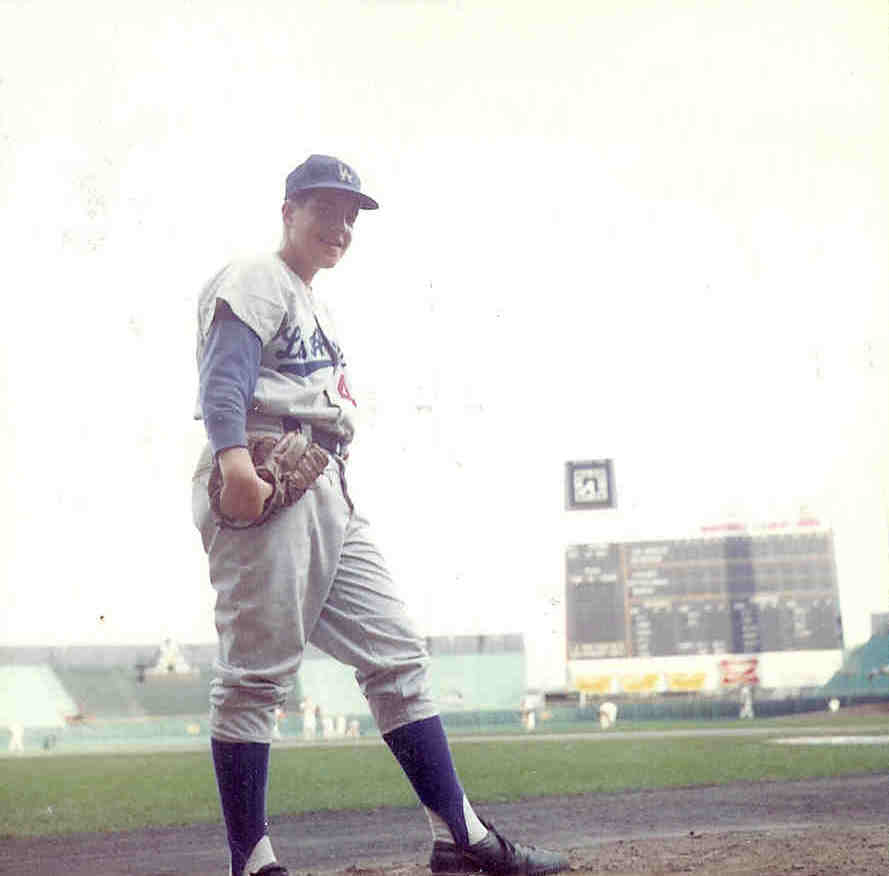 I had the tremendous fortune to join the Dodgers' official travel party on a complete 10-game road trip during the summer of 1965. For a 13-year-old aspiring pitcher, it was a wide-eyed experience to be treasured for a lifetime.
The Walter O'Malley Dodgers were the envy of baseball, traveling on their team-owned jetliner -- the "Kay O," named for O'Malley's wife, Kay. I accompanied Dad and the team on the plane, on the team bus rides, in the press box at each game, and even an occasion in the dugout and on the field during batting practice. Dad snuck in a couple of side excursions for me, as if he was afraid I may get bored.
Think about it. These were the Los Angeles Dodgers! Two years removed from their 1963 World Championship. Sandy Koufax, Don Drysdale, Maury Wills, and . . . well, OK, it was the pitching-dominated 1960's. Ron Fairly was the team's most productive hitter with an OPS of .768 (Rookie of the Year Jim Lefebvre and Lou Johnson led the team with 12 HR). But they were in first place in the National League en route to a pennant and another World Series win. And I was 13 years old! They were all superstars.
My recollection of the whole event begins with a quiet warning from Dad that he was waiving his parental discretion with the hope that I could ignore the profane banter that I was going to be subjected to round the clock. Heck, I don't even remember any remarks making an impression on me. I was 13, you know.
The stark contrast of 1965 to today is illustrated in so many ways. The Dodgers closed out a home stand at Dodger Stadium on Wednesday night, flew to Albuquerque on Thursday afternoon for an exhibition game against their Texas League AA affiliate on their way to a 10-game road trip beginning in St. Louis on Friday night, July 30.
With the help of a letter I wrote to home that has been thankfully archived in a scrapbook, a few details are available beyond the scant few that my memory has preserved. I wrote that 200 people, a red carpet and brass band greeted the team at the Albuquerque airport and a motorcycle cop-escorted motorcade paraded the team to the stadium for an evening game.
At the risk of unduly removing the luster from the story, I must admit one of my most vivid memories of the trip was the national anthem before that game. Due to tight seating arrangements for the big city press visiting the AA ballpark, I sat in a box seat behind the dugout with the Dodgers traveling secretary, Lee Scott, and the parents and daughter of Dodgers catcher John Roseboro. The unfortunate attempt by a soloist performing the Star Spangled Banner left Mr. Roseboro doubled over and many of the players on the field in obvious contortions trying to restrain their laughter.
 The game lasted until 10:30 p.m., the team plane took off at midnight and by the time we hit our room in St. Louis, it was 5 a.m. Friday with a game to be played that night -- most likely a then-typical 8 p.m. start time -- to open the four-game series against the Cardinals, the defending World Series champions. We slept past noon, then had breakfast with Wally Moon. The weekend-through-Monday stay in St. Louis included a visit to the zoo and a dip in the pool with Dodgers announcer Vin Scully. The press box in the old Busch Stadium (once known as Sportsman's Park) was Dad's least favorite in the league because its configuration created a particularly frightening view considering his fear of heights.
The Dodgers and Cardinals split the four games and the team was off to Milwaukee for a three-game set with the third-place Braves. It was to be the Braves' final season in County Stadium before the move to Atlanta. Tuesday's game was rained out in the first inning and made up as part of Wednesday's "twi-night doubleheader" as Dad described in his article. Perhaps the most exhilarating experience was the opportunity to don a Dodger uniform and spend some time in the dugout and a brief game of catch on the sidelines during pre-game warm-ups. (Three years later, I had the thrill of pitching batting practice to Dodger pitchers during the early batting rounds before a game at Dodger Stadium.)
 The teams split that doubleheader and the Dodgers took the series with a win in Thursday's finale behind Sandy Koufax's second complete game of the trip, his 12 strikeouts giving him 23 for the two starts on the trip. It was a magical season for Koufax on the way to his second of three Cy Young Awards. In 41 starts, he had 26 complete games and a 26-8 record. Oh, and he mixed in a couple of relief appearances that would have produced saves had they been an official stat at that time. He had an ERA of 2.04 and chalked up 382 strikeouts, breaking Rube Waddell's 61-year-old major league record. Did I mention a contrast between 1965 and today?
The final leg of the trip was a weekend in Cincinnati for three games against the second-place Reds in Crosley Field. The stay in Cincinnati provided the opportunity for the second excursion of the trip, an afternoon at River Downs racetrack with the other member of the Dodger broadcast team, Jerry Doggett. The trip ended on a bad note with an injury to Don Drysdale during an 18-0 drubbing by the Reds in the final game.
Along the way, the experience was awe-inspiring. Most notable of all was the dream like experience of being asked for autographs. It happened on a few occasions while traveling with the team. You see, I was within a few months of reaching six feet and 200 pounds. Maury Wills told me he thought I was a college student and Carroll Beringer asked me how many years of high school I had left. I took great joy in telling them, "I'm only 13!"
What a trip!
Tom Lederer manages sports and aquatics programs for the City of Lakewood, California, selected the number one Sportstown in California by Sports Illustrated.
| Baseball Beat/WTNY | April 20, 2005 |
One on One: Quick Takes
This week's One on One will be taking on a different face than last week, as Rich and Bryan get less long-winded and more quick-witted. Enjoy as the two make analogies, comparisons and surprising observations from what baseball has given us so far this season.
Rich: Take a bow if you thought Brett Myers would be the Phillies best pitcher and Gavin Floyd their worst pitcher this year.
Bryan: Ahh, classic Home Run Derby. If you ask me, I'm having some issues imagining the modern day version of the show featuring Brian Roberts against Clint Barmes.
Rich: I ran into Rob Bell at Bally's Fitness working off his ERA after the Yankees nailed him for 10 runs in 1 1/3 innings Monday night. For those of you who put a lot of meaning on groundball/flyball ratios, please note that Bell's was 6:1 that game.
Bryan: Well, I sure hope we can see a lot more extended visits from Tony Saunders and Bill Pulsipher at "Play It Again Sports," as Major League careers begin to be re-established.
Rich: Did anybody else take Justin Morneau in their fantasy draft before Paul Konerko? Man, somebody must have hit me on the side of the head that night.
Bryan: After watching Swisher hit an opposite field double this week, I maintain he's like Mo Vaughn on the Subway diet. That crouched stance, big inside-out power, and college pedigree make their resumes look like carbon copies. Not quite sure they could pass as twins, though.
Rich: There were four Golden Spike Award winners in uniform at the Dodgers-Padres game last weekend. Can you name them? (Hint: Robin Ventura is retired and Darren Dreifort was not in uniform.)
Bryan: We'll see whether Weaver regrets making the move as much as the Angels. One player who won't regret turning down seven figures is Andrew Miller at UNC, who despite a breakdown against Miami last week, has a 2.11 ERA and 69 strikeouts in 59.2 innings. It looks like Miller will be a solace to one lucky fan base from either Kansas City, Pittsburgh or Colorado.
Rich: Brian Lawrence reminds me of a poor man's Rick Reuschel in terms of his delivery, stuff, and control. If Reuschel doesn't get your attention, maybe this will: The Whale is one of just 30 pitchers in the history of baseball with 200 wins, 2000 Ks, and a 2:1 K/BB ratio (3000 or more IP). Of those eligible for the Hall of Fame, only six have yet to make it -- Bert Blyleven, Jim Kaat, Frank Tanana, Jerry Koosman, Mickey Lolich, and Reuschel.
Bryan: While much ado has been made of the great Florida rotation, and they have been fabulous, I might take the Red Sox pitching prospects if chosen. Boston's three best -- Jon Papelbon, Jon Lester, Anibal Sanchez -- entered Tuesday with a combined 59/4 strikeout-to-walk ratio. Those are the kind of peripherals that make Maddux and Spahn in their hey-days jealous, much less Dontrelle or Beckett.
So, in conclusion, do we have any guesses for the weight spread between Reuschel-Swisher and Vaughn-Lawrence? Please feel free to answer that question, any other asked today, and make an observation of your own in the comments.
| WTNY | April 19, 2005 |
Mulling a Middle Move
At shortstop, if you have to fill in, you're in trouble most of the time. The Defensive Spectrum is a necessary concept to explain why that is true because there is nobody drifting into the shortstop position because he failed at somewhere else.
-- Bill James in an interview with Rich Lederer
Despite scouts and signings calling for change, the minors' two best shortstop prospects have remained at their position this season. Playing on opposite ends of the East Coast, Hanley Ramirez and Joel Guzman are sinking their teeth into Double-A after what were breakout seasons for both in 2004.
Both signed from the Dominican as 16-year-olds, and Guzman immediately became well-known signing a record-setting contract. His $2.25 million bonus broke the mark previously set by Miguel Cabrera, and put a lot of pressure on the kid. Los Angeles was touting his five-tool talents, from his fast 60-times to his extraordinary pop in his bat. Despite signing in early July of 2001, the Dodgers left Guzman's professional debut until the following season.
Boston decided to do the same with their Dominican star, but having signed a year earlier left 2001 as Hanley's debut. The Red Sox stayed conservative with Hanley, leaving him near home playing in the Dominican Summer League. Ramirez finished having been named the Player of the Year, following a season in which he hit .345/.395/.533. Fifteen walks, thirteen steals and 25 extra-base hits in 197 at-bats was a sign of things to come for Ramirez.
The less-than-conservative Dodgers allowed their star to skip the Dominican League, starting him in the Gulf Coast League as a 17-year-old that summer. Ramirez was making his American debut that same season at the age of eighteen, and his star outshone that of Guzman. Boston left their switch-hitting talent in the GCL for most of the summer, where he would hit .341/.402/.555 and be named a league All-Star. Guzman hit just .212 with just two doubles in 33 at-bats before the Dodgers promoted him a year after being signed to the Pioneer League.
In their second league's that summer, again it was Hanley Ramirez that was best thought of. Ramirez took the rise to Lowell of the NYPL well, hitting .371/.400/.536. This was the first time that Hanley (who entered the league with a BB/K of 31/37 in 361 AB) struggled with plate discipline, walking just four times in 97 at-bats. This did not stop the Red Sox from naming Hanley their top position player from the Spinners. Los Angeles wished the same had been true for Guzman, who was very unprepared for the Pioneer League. Guzman hit .252/.331/.391, striking out in excess of 35% of hit at-bats.
Over the winter separating 2002 and 2003, Hanley Ramirez gave the Red Sox the first flaw to his resume. Boston sent their top prospect home during the Instructional League after the teenager cussed out an assistant trainer. This did not stop Red Sox brass from downplaying popular comparisons to Alfonso Soriano, and having international scouting director Louie Eljaua throw out Edgar Renteria's name.
Unfortunately, Ramirez continued to worry evaluators with maturity issues when making his full-season debut with Augusta in 2003. After off to a slow start in mid-May, Ramirez was sent to extended spring training (missing eight games) after making an "inappropriate gesture" towards a fan. Less than a month later Ramirez suffered a sprained shoulder during a brawl in which one newspaper reported Ramirez nearly went into the stands with a bat. While the Red Sox downplayed this incident, there was no question Hanley had a ways to go.
For the second straight season, Guzman joined Ramirez in 2003 in the South Atlantic League. While Hanley's summer was tainted with the maturity problems, Guzman continued to not have success and still get promoted. The Dodgers moved Joel to Vero Beach mid-summer despite Guzman hitting just .235/.263/.406 and having major issues with plate discipline. At this point in his young career, Guzman had 32 walks and 124 strikeouts in 401 walks. There was no significant change in Joel's numbers as he moved to the FSL, with a .650 OPS and very limited power. At the end of the 2003 season, Guzman had a frame too big for playing up the middle, and a .242 career average too small for the corners.
Doubts also started to cloud Ramirez' scouting report after 2003, where his play and his head gave him competition for the Red Sox top prospect slot. Hanley had just a .730 OPS in the South Atlantic League, committing more errors (36) than walks (32) in 111 games. Still, 36 steals and just one less extra-base hit gave Hanley Baseball America's top spot among Boston players. Boston promised their star would be a good citizen going forward, and comparisons to Edgar Renteria stayed despite his struggles.
In 2004, good things started to happen to the two shortstops that had been hyped for three years. Starting in the Florida State League, things began to click for the players. Guzman hit .307/.349/.550 in 87 games at Vero Beach, combatting selectivity problems with 44 extra-base hits in 329 at-bats. Ramirez played in 62 FSL games, hitting .310/.364/.389 with twelve steals and just 13 extra-base hits before a promotion.
Good things continued upon promotion to AA, as Guzman's numbers were just impacted by the .027 point loss on his batting average. He still hit more than 20 extra-base hits in less than 200 at-bats, and began to walk more often. Ramirez increased his plate discipline minimally, but showed improvements in his career stolen base (80%) and Isolated Power (.202) rates. Hanley actually bested Guzman's AA OPS numbers, but his power problems in FSL allowed Joel to jump Ramirez for the first time in prospect status.
Going forward, it remains to be seen whether these two players will move from their shortstop positions. Guzman's height, 78 inches tall, has led many scouts to question whether he will be able to stay up the middle. His defense has not suffered right now, but a move from Cesar Izturis to Guzman would likely be a serious reduction in range. A move to the hot corner or the outfield could be in order. Hanley might move to the outfield as well, possibly replacing Johnny Damon in center, after the Red Sox signed Edgar Renteria this past winter. The Red Sox have moved Dustin Pedroia to second and left Ramirez at short for the time being, leaving many to wonder if Hanley is simply the best trade bait available on the market.
Currently, Ramirez is continuing to get the best of AA, leading the Eastern League with five triples. Ramirez has yet to hit a home run, but the triples, stolen bases, discipline and small number of errors has made Hanley's start a good one. Guzman has not started the season so well, striking out thirteen times in his first 39 at-bats.
Right now, it looks like Hanley might be in the lead for the top spot, though the two remain neck and neck. A move to third for Guzman and to center for Hanley look to be the two most likely possibilities, but expect both to be left at short for as long as possible.
| Baseball Beat | April 18, 2005 |
This Day in Dodger Baseball
With the Los Angeles Dodgers (9-2) off to the best start in baseball, I thought it would be interesting to look into my Dad's archives and check out what happened on April 18th from 1958 (the Dodgers first year in L.A.) through 1968 (his last year covering the team).
1958 - Dodgers Nab Home Opener From S.F.
"The Dodgers came to Southern California Friday, but they were not the daffy Dodgers of old. The screwball role belonged solely to the San Francisco Giants, who lost an exciting, historic and at times hilarious 6-5 decision.
It was exciting in that the Giants had the tying run on second base with only one out in the ninth.
It was historic because 78,672 fans, the largest crowd ever to watch a regular major league single game, packed all but the peristyle end of the Coliseum.
And it was hilarious when the Giants had two runners camped on second base in the first inning and lost a run in the ninth when rookie Jim Davenport was called out for failing to touch third base.
Only three balls were hit against the much-discussed left field screen in this test tube contest, the first major league game played here. Three others cleared it and it was rookie Dodger third baseman Dick Gray's seventh inning home run that provided the margin of victory."
1959 - Cubs' Last Gasp Rally Falls Short
"Art Fowler, determined to make good in a comeback at the age of 36, pitched his heart out for four innings Saturday night but tired in the ninth and needed Johnny Klippstein's help to save an 8-7 Dodger victory over the Chicago Cubs.
A ladies night crowd of 27,466 saw the Cubs score three times in the ninth and threaten further when Klippstein struck out Sammy Taylor with the tying run on base. The paid attendance was 22,091.
Fowler, making his fourth appearance in seven games, took over after starter Danny McDevitt loaded the bases with none out in the fifth and turned in an incredible performance. The Cincinnati castoff was faced with the middle third of the Cubs' dangerous batting order, including Ernie Banks and Walt Moryn, who homered Friday, and Bobby Thomson, the greatest Dodger killer of them all."
1960 - Dodgers, Giants' TV Feud Renewed Today
"This is the city where, on Sept. 19 and 20 last year, the Dodgers pried open the golden gate to a pennant. They came here trailing by two games, won three and left with a one-game lead.
As Charlie Dressen once put it, "the Giants was dead." They were the victims of premature pennant fever and finally succumbed to too many long strokes.
Though Seals Stadium, the Giants' burial ground, was locked forever, it was a tough winter for San Francisco fans. The ill fortunes of the football 49ers made it seem that much longer.
Now it's spring again and the picture has changed materially in the past week. In the new environment of Candlestick Park the Giants gave birth to hope by matching the Dodgers with four victories in their first five games.
Much to the Dodgers' regret, the patient breathes again and it is fire that spews from the nostrils of the once wounded and still angry dragon.
It is in this setting that the two ancient rivals are to start their 1960 feud this afternoon with Johnny Podres pitching for the Dodgers against Bill O'Dell in a battle of lefthanders.
The two-game series will be televised over KTTV (11) and therein lies what may be the Dodgers first trump over a pennant contender. Television agrees with the Dodgers even more than it does with Ed Sullivan. The Dodgers won 9 of the 11 games televised from San Francisco last year, and then rose to stardom in the playoff and World Series, screened to a nationwide audience."
1961 - Howard, Moon Hit Homers; Boyer Two
"Dodger starting pitchers have yet to complete a game, but at least there is relief in sight for Larry Sherry, the one-man bullpen of the first week.
Rookies Jim Golden and Ron Perranoski silenced the St. Louis bats in the late innings Tuesday night and protected a 5-4 victory for Roger Craig and the Dodgers. Both took care of Daryl Spencer, whose grand-slam homer off Sherry dumped the Dodgers in Monday's opener."
1962 - Cincinnati Rakes 4 Dodger Pitchers for 14-0 Triumph
"Dodger pitching isn't what it's cracked up to be. It's just cracked up. And in more ways than one.
After trainer Bill Buhler cracked Johnny Podres' aching back and pronounced him unfit for duty Wednesday night a quartet of Dodger pitchers took a 14-0 massage from the Cincinnati Reds.
At this rate, Dodger statistician Allan Roth will have to compute his averages through Univac. In the last three games, Dodger pitchers have allowed 40 runs and 24 walks. For the still young season, they have issued 51 walks and watched 22 of the free-loaders score."
1963 - Dodger Bats Muzzled Again, Cubs Win 5-1
"It's too early to say that the Dodgers won't make a run for the pennant. But one run isn't going to be enough.
Thursday, for the third successive evening, Dodger hitters were as cool as the weather and they produced precisely one run. The result was a 5-1 victory for the Chicago Cubs, who took the sugar game of the series and dropped the Dodgers back to seventh place, three lengths behind Milwaukee.
Don Drysdale, who entered with a six-game winning streak over the Cubs, was the loser to Glen Hobbie, the last Cub pitcher to beat him. This upset took place on Aug. 17, 1960, when Ernie Banks homered in the ninth inning for a 1-0 win. Since then, Drysdale has won 43 games and Hobbie has won six, a piece of insignificant information which undoubtedly failed to show up on the Cubs' computer when head coach Bob Kennedy selected his pitcher."
1964 - Howard Spoils Reds' No-Hit Bid in Loss
"Saturday night is the lowliest hit night of the week at Dodger Stadium.
Three no-hitters have been pitched at Dodger Stadium on Saturday nights and the fourth eluded Jim Maloney and John Tsitouris by one strike. Frank Howard broke it up with a scratch single and the Reds had to settle for a one-hit, 3-0 victory.
Sandy Koufax, a two-time no-hit winner on Saturdays, was on the other end of the shutout as the Dodgers suffered their fourth successive defeat.
...Koufax allowed only three hits, all in the fourth inning, while losing for the first time since last Aug. 11. Cincinnati was the last team to beat him, 9-4. He had won 10 in a row, including two in the World Series.
Koufax never has won his first two starts. Last year he opened with a 2-1 victory over the Cubs, then lost at Houston, 5-4." [Ed. Note: Sandy broke his string the following year by winning his first two starts, both complete-game victories over the Phillies (6-2) and the Mets (2-1).]
1965 - Phils Nip Dodgers, 3-2
"All good things must come to an end. So, the Phillies ended the Dodgers' brief unbeaten and league-leading status by winning, 3-2, Saturday night.
But Don Drysdale wonders when the bad things will end. He and Bob Miller held the Phillies to four hits, which was good, but not good enough. All Drysdale received for his effort was his eighth successive defeat at the hands of the Quakers since June 1, 1962."
Headline of an adjoining article: Koufax Faces Biggest Test Today
"Two weeks ago, Sandy Koufax was worried about his arm and didn't know how frequently he would be able to pitch. Today, Koufax is still worried about his arm, but only because he hasn't had the opportunity to pitch.
'The only thing I'm worried about is that I haven't thrown enough,' Koufax said on the eve of his first regular-season appearance since Aug. 16. 'I've pitched exactly three innings since March 30 and I've thrown twice on the side in between. Everything else is fine. There's been no swelling in the elbow since I started to work again and I haven't had a bit of pain.'"
1966 - Dodgers 6, Astros 3 -- Sutton's First Win
"Don Sutton was three years old when Robin Roberts won his first major league game in 1948. Monday night Sutton achieved his first major league victory at the expense of the 39-year-old Roberts, who leads all active pitchers with 281 wins.
Sutton, though one inning short of going the distance as the Dodgers trimmed the Astros, 6-3, 'felt 9 1/2 feet tall.' He grinned from ear to ear, which covers a lot of territory, but said this thrill ranked second to his losing debut at Dodger Stadium last week.
'My biggest thrill was that standing ovation I got in L.A. when I left in the eighth inning. I'll never forget it. It made me feel 10 feet tall.'
Sutton's entire family was clustered around the radio, listening to the Houston broadcast in Molino, Fla., and his mother telephoned the clubhouse minutes after he entered. What did mother have to say?
'She wants me to make sure I brush after every meal,' Sutton reported.
There were no cavities in the Dodger attack Monday. Ron Fairly and Lou Johnson led the 13-hit display with three apiece and Maury Wills had a pair. Sutton himself chipped in with a key single and a sacrifice in the pasting that ran the Dodgers' winning streak to four."
1967 - First Dodger Win, 735th for O'Malley
"The rain, 'twas plain, could only end one chain.
After a dry spell of a week, the Dodgers have their first victory of the season, and to Walter O'Malley it must seem as if he had won a doubleheader. The original Smiling Irishman opened his gates for the 735th consecutive time, pocketed 17,947 paid admissions and watched the Dodgers climb out of the National League basement with a 7-2 conquest of the Reds.
The gates weren't closed until well after midnight because it was 12:04 when Phil Regan struck out pinch-hitter Art Shamsky for the final out.
Rain delayed the start of the game 13 minutes and interrupted it for an hour and 18 minutes in the seventh inning. During these periods it became obvious that the ground crew hadn't had any spring training in 10 years.
Only once since the Westward-Ho move in 1958 had a Dodger game been held up because of rain. That was last Sept. 18, against the Phillies, when the delay was only seven minutes and there wasn't enough time to run for the field cover."
1968 - Wes Parker: Dodgers' Shot in the Arm
"Wes Parker, batting .308 and leading the club with four extra-base hits, has given the Dodgers a shot in the arm.
Whether the shot is a cure-all miracle drug or will provide only temporary relief for the many batting headaches remains to be seen. Thursday, on an off day, they were waiting for the reaction.
'The thing we have to watch now,' said coach Danny Ozark, 'is his reaction after a trip like this. Because of his asthmatic condition, trips have been his biggest trouble. In the past he needed frequent rest, and Walter (Alston) always tried to give it to him by not starting him on the night before a coast-to-coast trip.'"
Just a random date in Dodger history. In these 11 years, the Dodgers played host to the largest crowd ever to watch a regular major league game, Don Drysdale and Sandy Koufax suffered early-season losses, Don Sutton's first big-league victory, and a rare rain-delayed game in Los Angeles.
What will happen this year? (For more complete coverage of the Dodgers, make Jon Weisman's Dodger Thoughts and Rob McMillin's 6-4-2 a part of your daily reading.)
| Baseball Beat | April 17, 2005 |
Home Runs to Remember
My nephew Troy turned 10 last Sunday. He lives in Phoenix. Troy celebrated his birthday by attending the Los Angeles Dodgers-Arizona Diamondbacks game. His favorite player is none other than Troy Glaus.
Can you think of a better present for a 10-year-old baseball fan than his favorite player going yard on his birthday? In a game he attended? The first time at bat? Well, that is exactly what Troy Glaus did last Sunday. He led off the second inning and drove a Derek Lowe offering over the fence in right field for a solo home run.
The Diamondbacks went on to win the game, 5-4, putting a big smile on my nephew's face. Although perhaps not on par with Babe Ruth and Johnny Sylvester, it's the type of script that is made for Hollywood.
Eight years ago, I witnessed an even more poignant home run first hand. It's my real life little Johnny story. Unfortunately, the boy wasn't at the game on his tenth birthday or in a hospital room rooting for his man to hit that special home run for him. You see, the boy that I am referring to had died in an automobile accident just a few days before that unforgettable game.
Michael O'Brien, the son of my close friend Dave, was a special kid. The Dad and I met when he was the athletic director at Long Beach State University during the first half of the 1990s. Michael was one of the ballboys at the men's basketball games. He watched those games from the baseline underneath the basket with a level of intentness belying his youth. I had no doubt that Michael was going to become a point guard or a scrappy middle infielder.
Dave and his family moved back to Philadelphia when he took the A.D. position at Temple University in 1996. His wife and boys were vacationing down the Jersey shore at his in-laws' summer home in August 1997. Dave had left earlier and was at Veterans Stadium on business the evening of the accident.
I learned about Mike's death the following morning when Dave's secretary called and told me that the O'Brien van was involved in a tragic collision with an oncoming car. Dave's wife and his two other sons survived the accident. A fourth son was not in the vehicle, deciding to stay behind with his grandparents.
Bill Husak, formerly Senior Associate Athletics Director at LBSU who went on to become the A.D. at Loyola Marymount University, and I went back for the funeral. Watching my good friend Dave eulogize his own son was one of the most moving events I have ever experienced. He mentioned that Mike was buried with some memorabilia of his favorite ballplayer, Jeff Bagwell.
Bill and I visited the O'Brien home after the service. We left after a couple of hours so the extended family could spend some time alone. On short notice, we actually found it easier to fly in and out of JFK than Philadelphia. While we were driving back to New York, we decided to check out the Astros-Mets game at Shea Stadium that Saturday evening.
Arriving almost an hour late, we walked to the Will Call window and told the gentleman that we were visiting from California in the hopes that he might be able to produce something better than the upper deck. Lo and behold, he reached into his shirt pocket and handed us two complimentary tickets for box seats directly behind home plate.
While walking into the stadium, we heard the type of noise that sounded like a home run from the visiting team. Yes, Mike's main man, Jeff Bagwell, took Bobby Jones deep to break a 1-1 tie in the top of the fourth inning. The first thing Bill and I saw was Bagwell touching home plate. We looked at each other and the same thought rushed through both of our minds.
Call it what you want. Divine intervention, a miracle, or a stroke of pure luck. But what were the Houston Astros doing in New York that evening? What were two guys from California -- only in town for a funeral -- doing at that ballgame? How is it that we were running an hour late, causing us to miss Bagwell's relatively uneventful first-inning walk but allowing us to first hear and then see Mikey's favorite player hitting a home run?
That's a pretty touching story, don't you think? Well, Mike wasn't quite through pulling the strings that evening. Although Bill and I had an early-morning flight on Sunday, we stuck it out for nine and, boy, were we rewarded for our perserverance. With two men on and one out in the top of the ninth, Bagwell hit another home run -- a game-winning, three-run poke off Mel Rojas.
After Billy Wagner mowed down the Mets in the bottom of the ninth, I called Dave from the ballpark to share the almost unbelievable events with him. On one hand, it was a difficult call to make so late on the day of his son's funeral. On the other hand, it was a moment I had to share with my pal. Dave thanked me and said he had no doubt that Mike was Bagwell's guardian angel that evening.
Mike's birthday is Tuesday, April 19. I will be thinking of him.
| WTNY | April 15, 2005 |
True Outcomes and Sample Sizes
At what point in the season do statistics start being complete enough to judge? Maybe after sixteen games (10% of the season), 32 games (20%), or even 40 games (25%)? My guess is that every person will have a different answer to this question, when they will start valuing a player's numbers for what he has become. Today my argument is that while it is too early to look at batting averages or slugging percentages, walks and strikeout totals are fair game.
So with that in mind, I set out to find the minor league players who are becoming sabermetric favorites and enemies in the early going. To qualify for the favorite category, a player had to be somewhat of a prospect and have already drawn more than five walks. Enemies had to have at most one walk, with at least seven strikeouts.
What is surprising is that in both categories combined, only four hitters have batting averages greater than .300. Both of these types are extremes as players, and to see them struggling in the early going is hardly shocking. While we'll surely check back in with this group at season's end, my hypothesis is that the walk-heavy players are more likely to bounce back.
Without further theorizing or hypothesizing, let's get to the players. First, the soon-to-be sabermetric favorites, by order of their current on-base percentages:
Well, those are all the players on my list to have at least eight walks this season. To quickly hit on the others, I should start with the PCL superstars, Casey Kotchman and Prince Fielder. Kotchman notched his first hit in more than twenty tries on Tuesday, not exactly sparking confidence in the Angels to trade Darin Erstad. Fielder has come out of the blocks a little slow (.217/.419/.478), but Lyle Overbay will allow him to take all the time he needs. As far as vaunted sluggers go, Eric Duncan is walking in the Eastern League, but the problem is existent in his .160 average and zero extra-base hits in 25 at-bats.
Last season we saw the Texas League eat up Jeff Mathis, and it will surely try to do the same to Mike Napoli this season. Napoli has a low average (.222) to go with a high slugging (.500) so far, making some wonder if he would be better than their favorite team's Major League back-up (he was available in the Rule 5). Russ Martin is a fellow Double-A catcher trying to succeed in the Southern League, fresh off a dazzling performance in Spring Training.
Tony Giarratano is another that impressed in the Grapefruit League, but has not come off the blocks fantastically in the Eastern League. Detroit fancies Giarratano as future help up the middle, but I'm worried his combination of low power, and moderate speed and defensive skills will hardly land him any full-time job. Eric Patterson is trying to take the same trek Giarratano did last year, and has started to impress in the Midwest League. Walks, power and tons of speed is not a package you always get from your second baseman, so us Cub fans have to keep our fingers crossed on this one. Finally I've also mentioned Kelly Johnson already, who like Espinosa before him, is right on the cusp of becoming a very useful bench player in Atlanta.
Alright, alright, I'm sick of being positive. Let's get to the players that new-age baseball fans won't be too fond of:
So, there you have it. My expectation is that unlike the averages of all the players mentioned today, which should greatly fluctuate, their IsoD's (OBP-BA) should remain either strong or weak. For while power and speed are skills, patience is a virtue.
| Designated Hitter | April 14, 2005 |
Slip Sliding Away
Every once in a while, I will pick a date in baseball history and take what happened on that date, and then play a game that I like to call "Slider."
I call it "Slider" for two reasons. First, because the object of the game is to "slide" from something on that date in baseball history to another baseball-related item, and keep the stream going for as long as you can manage. Secondly, I call it "Slider" because, as a batter, when you see a pitched baseball with a red "dot" on it, it's a "Slider." And, since what you aim to do in this exercise is to connect the dots, "Slider" just seemed to be a good name for this game.
For this episode of "Slider," I am going to start with October 16, 1962. This was the day that Game Seven of the 1962 World Series (between the New York Yankees and San Francisco Giants) was played at Candlestick Park in San Francisco.
Ordinarily, the winner-take-all game in a World Series is exciting enough as a standalone entity. However, there are some very interesting storylines associated to this particular game that make this one standout (to me) more than most other notable Series games. And, the majority of these storylines involve New York Yankees pitcher Ralph Terry.
Exactly two years and three days earlier, Ralph Terry was called into the 8th inning of Game Seven of the 1960 World Series (between the New York Yankees and Pittsburgh Pirates) to close out that frame. At that moment, it appeared as if Terry's effort in the 8th would be his final work for the 1960 season. The Yankees were losing the game by a score of nine to seven and were down to their final three outs. However, New York rallied for two runs in their half of the 9th and tied the game at nine. This gave Terry a chance to continue in the game. Unfortunately for Ralph, the first batter that he faced in that next inning was Bill Mazeroski and he hit a walk-off homerun to win the Series for the Pirates.
So, now, here is Ralph Terry in another Game Seven in 1962 with a chance for some World Series legacy redemption. However, just the fact that Terry was on the mound for this game required some divine intervention.
Ralph had pitched Game Two of the Series and then came back on normal (four days) rest to pitch Game Five. Terry won that Game Five with a complete game. The next two starting pitchers for New York after Game Five should have been a gimpy Bill Stafford or someone else (for Game Six) and then Whitey Ford (for Game Seven), if necessary. However, Hurricane Frieda hit the West Coast and brought cause for Game Five of the Series to be pushed back for three days. This delay enabled the Yankees to start Ford in Game Six and have Terry come back to throw Game Seven.
And, what a Game Seven it was for Ralph Terry. He had a Perfect Game going into the 6th inning which was broken up with two out in that frame when Jack Sanford (a pitcher!) of the Giants singled to right-center. Terry would go on to hold the Giants to two hits and no runs over the first eight innings. And, these innings were tight for Terry -- as the best the Yankees could do was scratch out one run in the 5th inning of the game.
This all led to the 9th inning of this game. Terry was still on the hill for New York and clinging to that one-nothing lead. Matty Alou led off the 9th for the Giants with a pinch-hit drag bunt single. However, Ralph rebounded to whiff the next two batters that he faced. Now, one out away from the win and the championship, Terry had to face Willie Mays.
Coming inside to Mays with his first two pitches, Ralph fell behind in the count. Next, Terry fired a fastball, low and away, that Mays managed to line into the right field corner for a double that would have tied the score (99 times out of 100) except the Yankees Roger Maris made a great play getting to the ball and holding Matty Alou to third base. Next up for the Giants was Willie McCovey (with the tying run now on third and the winning run on second). Yankees manager Ralph Houk elected to leave Ralph Terry in the game and they chose to pitch to McCovey (despite the open base at first).
McCovey fouled off the first pitch from Terry. On the next offering, McCovey uncoiled and launched a rocket line-drive. After the game, Willie called it "the hardest ball I ever hit." Unfortunately for the Giants, McCovey hit the ball towards Yankees second baseman Bobby Richardson who snared it at shoulder height for the final out of the game and the championship. As a result of all this, Game Seven of the 1962 World Series was one of the most exciting baseball games in history. And, in honor of Ralph Terry's contribution to this moment in baseball history, we are going to use him as our first sliding point in this edition of "Sliders."
In 1964, the Yankees traded Ralph Terry to the Cleveland Indians. In exchange, New York received pitcher Pedro Ramos.
Ramos would pitch with the Yankees through 1966 and then began to bounce around a bit. During his last year in the majors (1970) he pitched in a handful of games for the Washington Senators.
Pedro actually broke into the big leagues with Washington in 1955. However, that was the Washington team that moved to Minnesota in 1961. In fact, Ramos pitched the final Senators game in 1960 before they moved to become the Twins. The Washington team that Ramos joined in 1970 was the Senators that would eventually move to Texas (in 1972) and become the Rangers.
Jeff Burroughs was also a member (albeit for a brief period of time) of those 1970 Washington Senators. Burroughs was the first overall selection in the 1969 baseball draft. He was followed in the draft by J.R. Richard (who was selected second overall by the Houston Astros).
On July 30, 1980, J.R. Richard suffered a stroke during a workout and his major league career essentially ended on that date. On that same day, the Minnesota Twins Jerry Koosman pitched a 10-inning complete game, three-hit, victory (by the score of two to one) over the New York Yankees.
The next season, Koosman was traded to the Chicago White Sox in exchange for three players and cash. One of the players was Randy Johnson. No, it was not THAT Randy Johnson -- it was a then 23-year-old Designated Hitter named Randy Johnson who never really amounted to much in the big leagues. But, THIS Randy Johnson was born on August 15, 1958 -- the same date that Joe Cowley was born.
Joe Cowley, as a member of the Chicago White Sox, would go on to pitch one of the ugliest no-hitters in baseball history on September 19, 1986 (against the California Angels) when he walked seven batters during the contest (in a 7-1 win). Bob Boone scored the lone run for the Angels in this game.
Bob Boone retired from active playing in 1990 as a member of the Kansas City Royals. Jeff Conine would make his major league debut that same season, also with the Royals. The Royals would allow Conine to be taken in the 1992 Expansion Draft by the Florida Marlins. As a member of the Marlins, Jeff Conine would be named the Most Valuable Player in the 1995 All-Star Game. Conine came into the game as a pinch-hitter and homered in his first ever All-Star At Bat. The pitcher who surrendered the hit was Steve Ontiveros of the Oakland A's.
In 1994, Steve Ontiveros led the American League in ERA without the benefit of pitching a shutout during the entire season. The next pitcher to lead his league in ERA without registering a shutout would be Pedro Martinez in 2002 (with the Boston Red Sox).
Through 2004, Pedro Martinez hit 115 batters with pitches during the regular season in his career.
This Pedro tidbit allows for many sliding directions from this point. This is probably a good time to let someone else do the sliding. Take it from here for me. Feel free to continue this one in the comments options below. Thanks for following along this far. I hope this edition of "Sliders" was fun for you.
Steve Lombardi has been writing baseball-related content on the Internet since 1997. His first baseball book will be available in May 2005. For more information on the book, feel free to drop Steve a line at books@netshrine.com
| Baseball Beat/WTNY | April 13, 2005 |
One on One: First Impressions
Our Wednesday feature shifts from Two on Two to One on One. From previews to reviews of the early going. Having watched numerous games via MLB Extra Innings and MLB TV, we began to kick it around and decided to share our observations. We may or may not be right, but you can find out what we had to say right here, right now.
Rich: We're a week-and-a-half into the new baseball season. What has jumped out at you the most?
Bryan: While sample size caveats apply, I have definitely been intrigued by the parity we have seen. Towards the bottom of every division in the standings right now are teams that were picked at season's beginning: both New York teams, Cleveland, St. Louis, Oakland and San Fran. Now I'm hardly naive enough to think these teams will be in the basement all season, but to see teams like Toronto and the White Sox come out swinging puts a smile on my face. Soon enough we'll see the Yankees start winning two of every three games, and the standings will look somewhat like we all expected. But for now, I love that I can dream about NFL-like cinderella stories.
Rich: For me, I loved seeing the Yankees on the top steps of their dugout, clapping and showing respect for the Red Sox while they were getting their rings. That showed a lot of class. I give Joe Torre and his troops credit for showing such sportsmanship. Very refreshing.
On the other hand, I cannot for the life of me understand why MLB would schedule the Yankees and Red Sox twice during the first two weeks of the season. I think having two series like this in the first ten days is absolutely silly. I mean, this isn't NASCAR. I can understand the first one and would chalk that up to just being good for baseball. The second one? Redundant. Unnecessary. Anti-climatic. Overkill. Did I also say that it was just too much, too early?
Bryan: So what about individual players? While stats aren't ready to be evaluated yet, which players have caught your eye through eight or so games?
Rich: The Marlins starting pitchers have been very impressive. Three complete games already. Josh Beckett looks like a world beater. I won't remind everybody that I picked him to win the Cy Young. Oh well, I guess I just did. Hey, I don't want anyone to think I jumped on the bandwagon after the fact. He just flat out pounded the strike zone in his last outing. I saw him throw a 97-mph heater past Brad Wilkerson for his tenth strikeout of the game in the eighth inning. Very, very impressive. 15 innings, 17 Ks, and no runs.
Dontrelle Willis and AJ Burnett also had complete game victories. Although Burnett lost his first start vs. Atlanta, I thought he outpitched Tim Hudson. AJ just got a couple of bad breaks, but he looked really good. I wasn't surprised at all to see him mow down the Phillies Tuesday night. He kept his pitch count down by getting ahead of the hitters. He is virtually unhittable when he throws his fastball (which sits in the upper 90s) and knee-buckling curveball for strikes.
Bryan: Only two strikeouts behind Beckett on the season, and far more surprising, is Brett Myers. This is a guy that was one of the best pitching prospects in baseball a few years back, but like top Phillie prospect Marlon Byrd, has been nothing short of disappointing. Myers already has logged two quality starts, and looked great in the process. His curveball has bite like never before, and it appears he is starting to control his fastball. Could Myers be a 21st century version of Pete Harnisch, meeting expectations with a Cy Young age 24 season? After witnessing him pitch against the Marlins on the 11th, I am sold that this might be the year for Brett Myers. And if Rich is bragging about his Cy Young pick, might I mention Gavin Floyd -- my Rookie of the Year choice -- started the season magnificently against the mighty Cardinals?
Rich: Which hitters have made you sit up and take notice?
Bryan: I'll give you two players that reincarnated themselves by each losing twenty pounds over the winter: Carl Everett and Ivan Rodriguez. Everett is quickly making Chicago fans forget about the Big Hurt, and as I said when returning from Arizona, I think that is due to an increased work ethic. This team will have to make a big decision when Frank returns to the lineup, benching either Rowand or Podsednik.
Rodriguez drew praise from the announcing crew like crazy on Opening Day, after a winter in which he hired a dietician. I'm not so sure there is much more power left in Pudge's bat, but he can still contribute to the Tigers in a big way. If this is a guy that can hit well over .300 and continue to scare baserunners from stealing against him, the Tigers are getting enough bang for their buck.
Rich: Pat Burrell looks like he did three years ago. He had a month's worth of home runs and RBI in his first seven games. Three of his jacks were even hit on the road. For those who thought Miguel Cabrera might fall victim to a second full-season slump, let me tell you something -- you can fuhhgetaboutit. This guy is the real deal. I liken him to Manny Ramirez. Same position. Well-below average defensively. Raw power. Huge ceiling. A .300+, 40-HR guy in the making. Perhaps as early as this year. Put me in charge though and I would throw him in, in, and in. If advance scouts see what I see, Cabrera's biggest challenge will be in making the proper adjustments.
Bryan: So on to my favorite, the youngsters. Which young player -- bonus for naming a rookie -- has impressed you the most so far?
Rich: Danny Haren. I'm biased though. I drafted him for my fantasy team. I expected big things so I'm not at all surprised. In fact, like Joe Sheehan, I believe Haren will outpitch Mark Mulder this year. The guy throws a nasty splitter to go with his 93-95 mph fastball. I don't think he is the type of pitcher like a Beckett or a Burnett who will dominate, but I see him as a solid #3 type guy. He will undoubtedly have his ups and downs before the year is out, but I think his numbers will be just fine come October. This might turn out to be one of those trades people talk about years and years from now if it plays out like I think it will.
Bryan: I'm going to toot an unusual horn: Jorge De La Rosa. Currently the Brewer southpaw has the second-most strikeouts for a reliever, after a splendid two-inning, five strikeout performance on Sunday. De La Rosa had Len Kasper and Bob Brenly drooling as he went through the heart of the Cubs order in front of a packed Wrigley crowd. He struck out two batters with his big fastball (94-96 mph), and one with each of his other three pitches: slider (84-86 mph), change (83-85 mph) and a big curve (76-78 mph). His tendency to fall behind hitters makes me think he'll work better in the bullpen than the rotation, and with Mike Maddux's teaching, could be Milwaukee's answer at closer.
Rich: Interesting. OK, changing gears here, have you seen any bloopers thus far? Any plays that teams may leave on the cutting room floor when they put together their highlight reels for 2005?
Bryan: Sure, I'll give you two. First, the Opening Day disaster that was Braden Looper. It's quite sad that Beltran, Pedro and Jose Reyes are playing so well, and are surrounded by such a horrid bullpen. But the worst is undoubtedly Jason Ellison in the Dodgers-Giants game yesterday. Ellison, who came in as a defensive replacement in the eighth, completely missed a ball in left field that rolled to the wall for a Dodger victory. One of those one-in-a-million plays that makes us all wonder why baseball players make so much money. Either that, or it serves as a reminder why Ellison makes the minimum.
Rich: Well, I have seen some putrid fielding, too. Jason Giambi flat out dropping a pop foul ball the other day takes the cake for me because it just goes to show that Joe Torre won't be able to continue throwing Giambi's glove out there. Tino Martinez isn't the answer either. Where's Don Mattingly when you need him?
Speaking of first basemen, I also witnessed Jim Thome and Nick Johnson getting thrown out at home on two-out doubles. Man, these guys are slow. Thome and Johnson both looked like they were carrying pianos on their backs. Thome is a great player, and I don't want to demean him per se, but it makes me think that Johnson had better hit for more power if he is going to amount to much as a big-league first baseman.
Bryan: Let's close this out with a prospect evaluator's favorite: the comparison. Any players that have made you think you are seeing double in the early going?
Rich: David DeJesus reminds me of Johnny Damon. DeJesus is a bit older than Damon was in his second season, but they are both lefties who play CF with similar bodies, skillsets, and approaches at the plate. Rather than replacing Carlos Beltran, I see DeJesus as Damon reincarnated ten years later.
Bryan: I'm going to go with one I have wanted to make for awhile: Gustavo Chacin and Jarrod Washburn. Chacin has come out of the gate well in this season, and since learning a cut fastball shortly before the 2004 season, has been a very good pitcher. Washburn has always been said to throw his fastball well over 75% of the time, relying heavily on the heater. Neither will intimidate hitters much with their offspeed stuff -- both curveballs and change ups -- and must have control to succeed. Expect Chacin, who also has shown a bit of propensity for the home run, to have moderate Major League success. With little onus on him to sit atop the rotation, unlike Washburn in Anaheim, Chacin could flourish in the middle.
Rich: Thanks, Bryan. I'll check back with you next Wednesday. In the meantime, I'm curious what our readers have observed thus far?
| WTNY | April 12, 2005 |
Hindsight's Thinking
When does judging the quality of a draft first make sense? While researching for what this article was going to be -- early thoughts on the first round of the 2004 draft -- I asked myself this question. Is short-season ball, a few scouting reports and five games enough to start dissecting the resume of draftees? I don't think so.
Instead, my decision is the statute of limitations is one full season. Sure we can look back at drafts ten, twenty and thirty years old and have the best perspective, but one season is when becoming an armchair GM is first excusable.
With that being said, I wanted to look at the first 15 picks in the 2003 draft. Nine of these players were one of my top fifty prospects, far better than the lousy 2002 draft that preceded it. With criticizing drafts, we must remember to put these choices in the context of June, 2003, as things appeared far different at that time. Converting a draft pick into a Major League player is part scouting, part development and part luck. Forgetting any part of that equation and throwing all the blame on the person behind any of these choices is negligible.
Let us turn back the clock more than twenty months to early summer, 2003, with the Tampa Bay Devil Rays on the board. The organization wanted to put a star that could team with B.J. Upton on their organizational map, and use their first overall choice a little better than the first time (Josh Hamilton). Away we go...
Months before June, it appeared as the top of the draft heap did not offer much. Rickie Weeks was generally considered to be the top player, as the Southern University second baseman was well on his way to Golden Spikes' honors. Tampa Bay was not as sold on Weeks, and entertained options of Ryan Harvey, Marc Cornell and Kyle Sleeth with the first selection.
Over time, it became apparent that Chuck Lamar and staff were undecided between two players: Delmon Young and Weeks. Young was a California outfielder that had been hyped since Little League and had Major League pedigree to boot. Weeks finished up a ridiculous .500/.619/.987 season, drawing comparisons to Joe Morgan up the middle. Eventually, a batting practice session in Tropicana Field sold the organization on Young, allowing Weeks to fall into the Milwaukee Brewers laps with the second choice.
With almost two years between that decision and today, who would the Devil Rays choose? Young has become the top prospect in baseball since June of 2003, with advanced power and a good approach at the plate. Meanwhile, Weeks dominated low-A weeks after signing, ending the season in the Majors. His 2004 was a disappointment in the pitcher-friendly Southern League, showing flaws in his game both offensively and defensively. The presence of Jorge Cantu, along with the huge power advantage Young currently has indicates that the Devil Rays made the right decision. But in the end, this could turn out to be a choice between Albert Belle and Gary Sheffield.
Just as the first two picks became a choice of two sluggers, the Tigers and Padres were left fighting between college pitchers with the next two picks. Detroit had first dibs on the Sleeth-Stauffer selection, one (Sleeth) with a high ceiling and one (Stauffer) with considerable polish. Take a look at how the two compared in their sophomore and junior seasons combined:
Name	ERA	H/9	K/9	K/BB	HR/9
Sleeth	2.90	8.12	9.04	3.07	0.50
Stauff	1.73	6.82	9.90	3.40	0.31
As you can see, Richmond starter Tim Stauffer had the statistical edge. Obviously there is a strength of schedule difference between Stauffer at Richmond and Kyle Sleeth from Wake Forest, but the numbers still favor Stauffer. But radar gun readings and rumors of a sore Stauffer arm made the selection easy for the Tigers. Kyle Sleeth has not quite been a revelation since being chosen, but his struggles in AA last year could have been park related as much as anything else. Sleeth still profiles to be a Tiger starter, but his likelihood of succeeding is not like Stauffer, who has become a favorite of mine.
With the Kansas City Royals and Daniel Glass picking in the five spot, it was obvious that money would be an issue. The three best high school talents on the board (Ryan Harvey, Lastings Milledge, John Danks) all had high bonus demands, taking them off the Royal wish list. So it became obvious days before the draft that Chris Lubanski -- who had stated he wanted to be reporting to the minors by June 15 -- was the Royals best option.
Lubanski ended up signing quickly with the Royals for $2.1M, making $25,000 more than Milledge and the same as Danks. Harvey inked for $2.4M, but considering that all three players are far better prospects than the man with the .662 OPS, the Royals screwed up here. Lastings Milledge turned out to be the best choice, and with proper communication with his agent would have saved the club money. Considering the failure that the five-turned-zero tool Lubanski has been.
Solace for a horrible 2002 season to north side Chicagoans was Ryan Harvey, a Florida outfielder with huge power. Brian Dopirak's former high school teammate became "Sammy Sosa's successor" like that, and the Cubs slow-moving system has left his prospect status a bit cloudy. 2005 will be Harvey's full-season debut, as he must start to turn his tools into talent. After two games we see the strikeouts might be a problem, with five already in eight at-bats.
With the seventh choice in the draft, the Baltimore Orioles were the first real spot with a considerable amount of uncertainty. Ian Stewart and Michael Aubrey were both considered to be the projected choices here, up until the Nick Markakis workout in Baltimore. Markakis' Greek roots and pitcher/hitter athleticism made him a favorite of both Peter Angelos and Doc Rodgers alike. While Markakis had been offered a pre-draft deal with the Reds, the Junior College Player of the Year made more than $300,000 extra signing with the O's.
For some reason or another, the Pirates have not made a secret of their choices in recent memory. Neil Walker, a hometown native, was a Pirate in nearly every mock draft published last June. In 2002, Bryan Bullington was given the nod ahead of B.J. Upton weeks in advance. In this draft, the choice was Paul Maholm, the third best college pitcher, and one of just four collegiate starters drafted in the first round. Given the fall-off from Sleeth and Stauffer to Maholm and Sullivan, this is arguably one of the worst first rounds for collegiate pitching ever. I'm sure the team would have loved to have the money to sign Jeff Allison, but now even Maholm looks good in comparison. Hindsight is 20-20, I guess.
The next four choices, picks 9-13, were all simply the best player available. Grady Fuson shed his label of a college-only drafter by choosing John Danks, Colorado picked a Californian slugger, Cleveland landed a polished college first baseman, and New York an expensive, mature-lacking but tools-heavy outfielder. Criticizing any of the choices here would be wrong, as all four picks were among my top thirty prospects. The order of the four is Stewart, Milledge, Aubrey and Danks, but it is hard to criticize the Rangers for adding pitching depth and the Indians for a college-first philosophy.
With the thirteenth choice, J.P. Riccardi and company decided to throw the media for a curve. After weeks of tooting Brad Sullivan's horn, the Jays decided the Houston right-hander was a reach, and collegiate pitching could be found in later rounds. They instead found Aaron Hill, a shortstop from LSU, who had been a favorite of college-focused organizations like Boston and Cleveland later in the teens. While Hill played the same position as the new Jays regime's premier first-round pick, Russ Adams, the organization decided it was a good problem to have. While Hill has not blossomed the way it was hoped, he looks to be an alright prospect with a bit of power potential.
Did they reach their college pitching in later rounds goal? Kind of. Eleven of their next thirteen selections were hurlers from college, though it doesn't appear as they landed any blue-chippers. Both Josh Banks and Jamie Vermilyea have shown some potential, and certainly Shaun Marcum, Kurt Isenberg and Tom Mastny are nice fillers for minor league rotations. Brad Sullivan's dead arm in the Oakland organization has made this pick look good for J.P., who probably still wishes that his first two first-round picks had been Jeff Francis and Michael Aubrey.
Cincinnati has always been a fan of the pre-draft deal, as Carl Lindner's frugal ways put a bit of a strain on the Reds. This year was no exception, as the team heavily pursued the likes of Markakis and Eric Duncan before the draft. While both of those players were offensive projects with considerably potential, the actual fourteenth selection was quite the opposite. Ryan Wagner had succeeded in taking the reins from Jesse Crain at the Houston closer position, and following a NCAA record-setting season (K/9), Wagner looked as if he could help teams right away.
So he did, pitching in nine minor league games before receiving a call to Cincy. He was arguably the club's best reliever the last month of the season, putting a considerable onus on the 22-year-old as Danny Graves' set-up man in 2004. After a horrible start to the season Wagner was sent down, and after re-finding his stuff in 15 AAA appearances, closed out the season well. Wagner is still the Reds' future closer, and his pick still makes more sense than fellow 2003 first-round relievers Chad Cordero and David Aardsma.
Finally, there is Ken Williams, who surprised some people with his selection of Arizona outfielder Brian Anderson. Teamed with Ryan Sweeney in the second round, the two outfielders have been well thought of since that day in June. Both players could have everyday jobs on the south side in 2006, when Jermaine Dye's two-year contract in right field ends. It is amazing how quick Jeremy Reed and Joe Borchard were thrown off the organizational ladder for these two, and time will tell if that was a good decision. But for now, Anderson was a great choice at fifteen.
So there you have it. Kansas City is really the only team with an obvious screw up, though Detroit and Pittsburgh also opened themselves up for criticism. With an important season on tap for Sleeth, Harvey, Markakis and Hill, another year will only further help us grade out this draft. Time and hindsight vision is all an armchair GM needs for constant success.
| Baseball Beat | April 11, 2005 |
Ball Games
When I was a kid, we played a lot of baseball. Organized and unorganized. Spring, summer, fall, and winter. Morning, noon, and night.
The first organized league I joined was at the local park. It was called the Ice Cream League and my team was the Chocolates. Hey, don't blame me. I didn't make up the name of the league or my team. But, I'll tell you one thing, we sure beat up on those Vanillas and Strawberrys.
After park league, I graduated to Little League. I was one of the few kids who was drafted into the majors as a nine-year-old (bottom row, left). Wink, wink. Our manager -- Mr. Martinez (yes, he'll always be Mister to me) -- had the exclusive rights to me because my older brother Tom (the lefty in the back row) was on the team. Mr. Martinez took me and I played for him all four years.

The name of our team was the Yankees. You know, the Yankees with the green letters, hats, piping on the sides of our pants, and stirrups. We didn't have George Steinbrenner's money behind us so we had to wear big patches on the back of our flannel jerseys with the name of our sponsor.
One year it was a local laundromat, another year it was Sparrow Realty. Man, I had so many patches on my jersey, it felt like I was carrying five more pounds than necessary. I was always a big kid for my age so I didn't need any extra weight to lug around. Heck, I was so slow, my high school coach used to give me a hard time by timing me with a calendar when I ran from home to first. I can hear him now, "April, May, June..." Cruel. But one helluva coach.
In between Little League and high school, I played two years of Pony League and two more years of Colt League. I also played Connie Mack and American Legion in the summers during high school plus a couple of years in what was called a scout's league during the winter.
Although I played at least ten years of organized ball, some of my favorite memories involve pickup games with my brothers and the kids from the neighborhood. Gosh, I even enjoyed playing baseball by myself. I would throw the ball as a pitcher against our brick planter, then turn into a fielder when the ball bounced back to me. On occasion, I would lob the ball onto our sloped roof and play outfielder.
 When I wasn't just chillin' in the backyard (resting on my catcher's mitt), I was either recreating a Dodgers game I had just attended or perhaps making up my own game while listening to Vin Scully on the radio. Give me a rubber ball (note the condition of the one next to me in the photo) or a tennis ball. They both did the job. Hardballs were generally limited to the times we played catch because we didn't want to rough 'em up. Besides, real baseballs just didn't do the trick when it came to throwing against a planter or a wall or off a rooftop.
We played all sorts of games from the more conventional over-the-line (also known as "hot box"), home-run derby or pickle to what we called first and short(stop), pitcher and catcher or swing the bats. The latter was something I made up as a youngster. It would almost always be played on a Sunday in the early evening, immediately upon returning from an afternoon game at Dodger Stadium. I would keep score of the game, then play it once again all by myself in the backyard. It was called "Swing the Bats" because I would mimic Maury Wills, Jim Gilliam, Willie Davis, and the opposition by swinging the bat (from the left or right side, exactly like each hitter) at an imaginary pitch and running the bases accordingly.
I had an aunt who would watch me through the kitchen window. To this day, she teases me for staging the commercials ("Blatz is Milwaukee's finest beer!") and stopping action for the proverbial station identification. I even went so far as to provide cheers and boos from the crowd, always whistling when the Dodgers scored a run or won a game.
Call me nuts -- I'm sure Aunt Kathy had her doubts -- but these ball games meant the world to me back then. As I got older, Swing the Bats turned into wiffle ball and games using ping pong balls and the orange 76 Union balls (that were meant to be placed atop the radio antennas on cars for identification purposes) as the baseballs of choice. We also brought out our Larry Sherry Pitchback, a large, rectangular frame attached to elastic netting that allowed you to play catch with yourself, when it wasn't broken, and we occasionally played Sacket, a one-on-one baseball game, at the local park.
Depending on the type of game, we used wood or plastic bats. I was particularly fond of a game-used Lou Brock bat that was given to me by the Cardinals batboy one afternoon. It was broken but I made it work by driving a few nails into the pine-tar-covered handle. The bat must have weighed 34 ounces (or about two to four more than I could realistically handle in my pre-teen days) and, of course, the wood bat was not ideal for hitting wiffle, ping pong, and styrofoam type balls. But that didn't matter much to me because I was swinging the real deal.
If we weren't playing ball at home, we walked or rode our bikes (with gloves hanging on the handle bars) to the nearest park or school. Some of our best over-the-line and home-run derby games were played on a grassy area at a community college. I think what strikes me most when looking back is the fact that we put these games together without the involvement of any coaches, umpires, or parents. What a concept!
Let me tell ya, dem were the days.
[Additional reader comments and retorts at Baseball Primer.]
| Baseball Beat | April 09, 2005 |
Just Wondering
The weekend edition of Baseball Beat brings you a Dusty Baker dozen questions for your consideration.
C: Earl Battey and Jerry Zimmerman
1B: Harmon Killebrew and Rich Reese
2B: Jerry Kindall and Bernie Allen
SS: Zoilo Versalles
3B: Rich Rollins
OF: Bob Allison, Jimmy Hall, and Joe Nossek
SP: Jim Kaat, Jim Perry, Dave Boswell, and Jim Merritt
RP: Johnny Klippstein
Tony Oliva, who replaced Lenny Green the previous year, and Don Mincher were the only position players who did not have back-to-back identical letters in their last names.
Did I mention that the Twins also had a relief pitcher by the name of Garry Roggenburk?
Saberhagen, the son of two-time Cy Young Award winner Bret, is a freshman pitcher. Sandberg, the son of Cubs Hall of Fame second baseman Ryne, is a redshirt sophomore backup infielder. Tracy, the son of Dodgers manager Jim, is the starting catcher. He leads the Waves in batting average (.366), HR (6), RBI (32), OBP (.420), and SLG (.626). The younger Tracy was selected as a freshman All-American by Collegiate Baseball last year.
"It's a combination power hook/slider. I've seen some great breaking pitches over the years -- Nolan Ryan, Don Sutton, Bert Blyleven, guys that really spin the ball. As far as power breaking pitches, (Rodriguez) might be at the top of the list."
        IP    HR    BB    SO    ERA
2002   233    17    62   208   3.01
2004   237    17    62   206   3.49
Although the Houston pitcher gave up 18 more hits (233 vs. 215) last year, his batting average on balls in play (BABIP) was not significantly different (.287 in 2002 and .300 in 2004). However, these extra hits were all in the form of doubles (57 vs. 39).
| WTNY | April 08, 2005 |
Tripled Up
"I don't get to see a lot of minor leaguers...Triple-A just doesn't get to see the 'best prospects.'"
- Will Carroll, in a 4/4 Baseball Prospectus Chat
Last season, just eight prominent prospects (Sizemore, Hardy, Krynzel, Claussen, Youkilis, Adams, Quiroz, Rios) started the season in the International League. It did not take long for Brandon Claussen, Kevin Youkilis and Alexis Rios to make the Majors, and J.J. Hardy suffered a season-ending injury in May. Will, an Indianapolis native and frequent at Victory Field, just did not see the blue-chip prospects that Texas or California League natives did.
A year later, the International League has become a hotbed for prospects. With many of the best prospects on the horizon, the fourteen organizations with affiliates have sent some of their top players to AAA. This time around, a whopping 15 players that would make my top 150 prospect list (if it existed) are in Carroll territory. Furthermore, some very good "sophomores" are back on the farm after uninspiring springs as well.
After being ranked baseball's best prospect by a few different places, Andy Marte will move to Richmond this year as his trek through the Atlanta system continues. On Wednesday it looked as if Chipper Jones may have hurt himself a few times, which at this point is all Marte needs for the door to open. The outfield expirament has been abandoned, meaning a Jones injury or position change (not likely) is what Marte needs to reach the Majors. We'll see what happens this coming winter on the Chipper front, because he will either be moving back to left or find himself on the trading block.
On Richmond's opening day, Marte will find himself playing defense for Kyle Davies. I've written numerous times how high the Atlanta organization is on Davies, and that he may have an impact on the NL East race. There is much debate about just how good his stuff is, or how injury-prone his delivery makes him, but this is a case of just having to trust the Braves' front office. Considering the men Davies replaced from the "Top Brave Pitching Prospect" slot -- Jose Capellan and Dan Meyer -- had a combined 2.67 ERA in 104 innings last year, expect Davies to have success.
Beating out Davies for the IL's best pitching prospect is Brandon McCarthy, one of the 2005 Cactus League stars. Ken Rosenthal has talked about how McCarthy had one of Arizona's best breaking pitches, making some wonder how it will break out of the desert. Great control and a serious out pitch will likely mean that McCarthy won't get to 15 starts before getting called up; Jon Garland and Jose Contreras have very little room for error.
Playing behind McCarthy will be Brian Anderson, the White Sox former first-round pick. If it is fair to say Kyle Davies allowed the Braves to trade Capellan and Meyer, than Anderson's presence was enough to deal Jeremy Reed. There is not a lot that Anderson does wrong, and playing a full season at the minors' highest level should do a lot for his stock. My belief is that Aaron Rowand will regress considerably this year, opening the door for Anderson in 2006. An increase in power will make him one of baseball's top twenty prospects quickly.
Curtis Granderson will be standing in Anderson's way for the IL CF All-Star spot. The latter should win, but Granderson will also set himself up for a 2006 job. I believe that moving out of Erie will significantly decrease Curtis' OPS, but if he proves to be the player he was in August, I'll be proven wrong. He could platoon with Craig Monroe by season's end, setting himself up for a full-time job once he proves he can hit southpaws.
One prospect that has already proven everything that he can is Ryan Howard from the Phillies. Jim Thome is putting the bat-block on Howard's development, prompting the first baseman to ask the Phillies for a trade. He and Marlon Byrd make a very good combination, giving Ed Wade a serious bargaining chip in negotiations. There aren't a lot of bad teams that couldn't use Howard, though I must say that I'm far less confident in his abilities than a lot of people.
On the other hand, Francisco Rosario of the Blue Jays is a player that I am higher on than most. The big right-hander is pretty assured of landing some role with the Blue Jays in the next two years, and this will be the season to decide whether that will be in the rotation or the bullpen. This being his second season back from arm surgery, I expect Rosario to have his best year yet in Syracuse.
His battery mate will be, when fully recovered from a minor injury, Guillermo Quiroz. A great prospect before 2004 that lost a lot of value this year, the Blue Jays still believe that Quiroz will be their everyday catcher in 2006. Quiroz has both defense and power, but will be overshadowed (again) by the Skychiefs' shortstop. Aaron Hill takes over those duties from Russ Adams this year, the man he expects to compete with in a year. I like Hill at short and Adams at second, making Orlando Hudson the man dealt for pitching.
Edwin Encarnacion is a one-time shortstop that has already made the switch, one over to the hot corner. Encarnacion was probably not pleased to see Joe Randa -- who he is set to replace in 2006 -- start the season so well, but it should not stop the Reds from bringing up Edwin fairly soon. If anything, Randa should give Cincy a good person to trade (with Griffey?) in July, when Edwin should be ready. But I have noticed the Cincinnati front office is not too high on Encarnacion, indicating he might be the odd man out. Man, could you imagine what a Encarnacion/Wily Mo Pena package would yield?
Maybe that could allow Minnesota to make a trade, as they are finding far more depth in the rotation that they would have imagined. Scott Baker pitched extraordinarily well in Spring Training, prompting some to wonder if he had moved ahead of J.D. Durbin on the organizational depth chart. The two will slug it out in the next two months, waiting for a chance to break the rotation. Durbin could also become a reliever, adding to what Peter Gammons has already coined the deepest power bullpen in baseball.
It's poise, not power, that makes Zach Duke one of the Pirates best prospects. The soft-throwing southpaw drew the repsonsibility of facing Curt Schilling in his opener, and was not overshadowed, besting the superstar in a game yesterday. Duke will be called up the second he shows that the International League is not a problem for him, which should not be long. Seldom should you listen to Tom Glavine comparisons, but Duke might be the exception to the rule.
One final player to watch in the International League is Ryan Garko, the Matt LeCroy/Josh Phelps-type hitter from the Indian system. Where Garko fits into the Indians future is a bit in question, but they will not give up on that bat. Garko will be joined in Buffalo by Brandon Phillips, who lost the SS battle with Jhonny Peralta. After looking good in the league last year, Phillips only has so many more things to prove until he moves to another organization. It also looked as if neither of these players would be the best Bison, as only a Juan Gonzalez injury saved Grady Sizemore from being sent down. Why the Indians would make this decision is beyond me -- Sizemore could be the best of the Cleveland outfielders -- but I have also learned to always trust Mark Shapiro.
Who I cannot trust, however, is Chuck Lamar. The Devil Rays decided during Spring Training that B.J. Upton, who should be a household name by now, will go back to Durham. What the Devil Rays should have done was keep Upton at shortstop, move Lugo to second, and the red-hot Cantu to third. Alex Gonzalez might have a home run already this season, but call me crazy, I don't think he'll be around when Delmon Young is ready to turn this team into a contender.
I have no doubt that this season, dozens of good players will stroll through the International League. Will Carroll, just another IL fan constantly disgusted with the quad-A talent he sees, will find this year a welcome contrast. And in 2006, we will all find the Majors a stark contrast with dozens of young players...all of whom came from triple-A.
| Designated Hitter | April 07, 2005 |
Picturing Baseball
Since you're here reading the fine Baseball Analysts site, I assume you've read a lot of baseball articles already. Along the way, you've probably seen a lot of tables that look like this:
CLUB          W       L       RS      RA   Pyth Diff
STL          105      57     855     659       5
ATL           96      66     803     668       1
LAD           93      69     761     684       4
HOU           92      70     803     698       1
SFG           91      71     850     770       3
CHC           89      73     789     665      -5
SDP           87      75     768     705       0
PHI           86      76     840     781       0
FLO           83      79     718     700       0
CIN           76      86     750     907       9
PIT           72      89     680     744      -2
NYM           71      91     684     731      -5
COL           68      94     833     923      -5
MIL           67      94     634     757       0
MON           67      95     635     769       0
ARI           51     111     615     899      -3
This is a pretty important table, actually. It includes the wins and losses of all National League teams last year, plus their runs scored and allowed and their "pythagorean variance," which is the difference between the number of wins you'd expect from each team based on its runs scored and allowed, and its actual wins. Arguably, this table contains the most important, fundamental stats of the season for each team.
Let's say you're a Reds' fan. Because the list is sorted by number of wins, you can see that the Reds finished seventh from the bottom of the NL, with 76 victories. You can also see that they scored 750 runs, which is in the middle of the pack somewhere, but allowed 907 runs, which looks like the second-worst total. Finally, you see they actually outperformed their Pythagorean projection by nine games.
As I said, that's a lot of information, and it took a bit of work to pull these facts out of the table. And that was just one team -- imagine being a general baseball fan and wanting to understand the big picture; wanting to understand how all sixteen teams relate to each other. If you can imagine how frustrating that would be, then you grasp the essence of my pet peeve: the overwhelming terrible use of numbers in baseball writing. I'm not talking about the analysis of the numbers (though that often misses the mark, too). I'm talking about the way the numbers are displayed.
Specifically, I'm talking about articles in which the writer uses stats to make a point. Don't you think that the writer should present the stats in a way that highlights the point? And that doesn't force readers to cross their eyes and furrow their brows?
Yes, baseball stats are an integral part of the game. Yes, the MacMillan Baseball Encyclopedia was probably the best Christmas present I ever received. Yes, our understanding of the game is deepened and strengthened by the insightful use of baseball stats.
But that doesn't mean that every interesting baseball article has to include tables of stats. Just because it works for the Baseball Encyclopedia doesn't mean that it works for a magazine, newspaper or website. In fact, research has pretty conclusively shown that tables do a poor job of making a point. Readers don't take the time to read them and often don't understand them.
Okay, that's the first half of the rant. Now for the second half: too often, publications that do graphs do them completely wrong. Recently, Baseball America ran a graph of contract information that consisted of blue bars on a blue background, which inspired a rant at my website. But I shouldn't just pick on BA. USA Today, that popularizer of the pie chart and other specious graph designs, has probably done more to undermine the notion of good graph design than any publication in the history of publishing.
On the other hand, we have the New York Times, which in my opinion consistently shows a phenomenally insightful touch with their graphics. The Times, as you know, is supposed to be written for high-minded intellectuals who live in New York; USA Today is supposed to written for the average person who lives everywhere else. As a result, there is a perception that graphics are "devices for showing the obvious to the ignorant." No, no, no. Graphs can convey "complex information, as long as it's done with grace and clarity," in the words of Edward Tufte, the Godfather of Good Graph Design. Let me give you an example.
Here is a graph of runs scored and allowed by each team in the National League last year, adjusted by park factor. Teams that scored a lot of runs are on the right, while teams that gave up the least runs are at the top of the graph. Some folks object to this graph layout, because the "Runs Allowed" axis runs from high on the bottom to low on the top, instead of low to high. I've done that for a reason. Most people associate "up" and "right" with a good outcome, because larger numbers are usually good. So I ran the axis such that the best position is in the upper right hand part of the graph, and the worst position is in the lower left. I've also added dotted lines depicting the average number of runs per game, and added a couple of labels (good offense, bad defense, etc.) to help understand the graph. Finally, I've added the pythagorean variance to the team label, so that you can see how the team's actual won/loss record differed from its relative position on the graph.
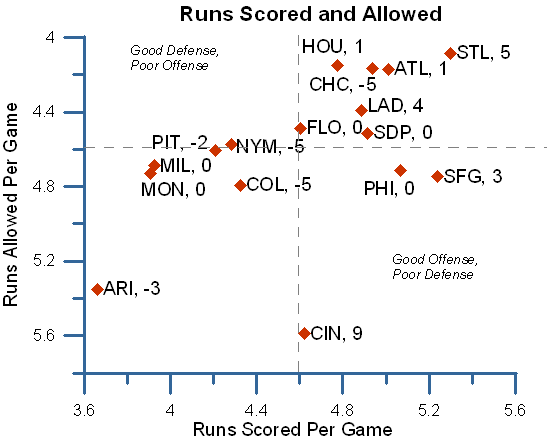
The reason to graph this information is that runs scored and allowed are directly related to wins and losses, and the depiction of spatial relationships for each team lets you understand each team's strengths and weaknesses. Cincinnati was not only the worst defensive team in the league, it was WAY worse than every team other than Arizona. And St. Louis was clearly the best team in the league, as evidenced by its position in the upper right corner.
But the graph can be improved by substituting different lines -- ones that show the implied won/loss record of each team. Specifically, the three lines in the following graph now represent projected victory totals at three levels, with winning percentages of .400, .500 and .600. These lines allow you to group the teams by performance levels, regardless of whether they rely on pitching or hitting.
![runstwo[2].GIF](http://baseballanalysts.com/archives/runstwo[2].GIF)
Now you can see that Cincinnati and Montreal were both .400 teams, but one was built on offense and the other on defense (note the ironic use of "built"). St. Louis was the only team clearly over the .600 mark, while the Cubs and Braves were slightly under that line -- the Cubs were hurt by their Pythagorean difference. It's true that you don't have the exact number of wins, losses, runs scored or runs allowed on this graph, but why do you care? You can get that information from lots of other websites. This graph allows you to see the critical relationships in ways a table of numbers can't. Applying some of Tufte's criteria, this graph gives the viewer the greatest number of ideas in the shortest time with the least ink in the smallest space. That's a mouthful, but that's also the goal.
To paraphrase Edward Tufte one last time, the objective of graphical representations is to facilitate better reasoning about quantitative data. Good graphs allow the reader to focus on the substance of the data and determine the cause and effect relationships. Tables of numbers don't do this well at all, and neither do poorly designed graphs. But well-designed graphs can show the way.
I took up this cause two years ago, with the creation of the Baseball Graphs website. The good news is that lots of other folks are joining in. Here are some other recent examples of excellent baseball graphs:
* Historical Baseball Trends
* David Pinto's fielding graphs
* Andrew Drake's superb Major League Charts
* John Burnson's book The Graphical Pitcher
* Hardball Times division races
Since first rolling out the baseball graphs site, I've moved onto a lot of other projects at The Hardball Times, such as Win Shares, WPA and even writing weekly columns. But good graphical displays remain my top priority and my raison d'etre on the Web. The cause is gaining steam, but it still has far to go. I thank Bryan and Rich for the chance to get on my soapbox once again.
Studes is a writer at the Hardball Times, and also the manager of the Baseball Graphs website.
| Baseball Beat/WTNY | April 06, 2005 |
Survey Says...
We have extended our Two on Two previews among all of our panelists to include everyone's picks for each of the division, wild card, and league championship winners, as well as the World Series champions, traditional award winners, and several other "fun" categories.
With us once again today are JD Arney (Red Reporter), Tyler Bleszinski (Athletics Nation), Brian Borawski (TigerBlog and The Hardball Times), Alex Ciepley (Cub Town), Brad Dowdy (No Pepper), Aaron Gleeman (Aaron Gleeman.com and The Hardball Times), Jason Mastaitis (Always Amazin' and MetsGeek), John Perricone (Only Baseball Matters), Jeff Shaw (U.S.S. Mariner), Patrick Sullivan (The House That Dewey Built), and Jon Weisman (Dodger Thoughts).
Although not meant to be a family feud among baseball bloggers, some of our responses may not be met with clapping and the proverbial, "Good answer."
	West	Cent	East	Wild
Aaron	OAK	MIN	BOS	NYY
Alex	LAA	MIN	BOS	NYY
Blez	LAA	MIN	NYY
Brad	LAA	MIN	BOS	NYY
Brian	OAK	MIN	NYY	BOS
Bryan	LAA	CLE	BOS	NYY
Jason	OAK	MIN	BOS	LAA
JD	OAK	CLE	BOS	NYY
Jeff	LAA	MIN	BOS
John	LAA	MIN	NYY	BOS
Jon	LAA	MIN	BOS	NYY
Rich	OAK	MIN	BOS	NYY
Sully	OAK	MIN	BOS	NYY
The Baseball Analysts consensus has the Angels nipping the A's in the West, the Twins taking the Central, the Red Sox winning the East, and the Yankees making the playoffs via the Wild Card.
In the National League, the panelists see the Dodgers winning out West, the Cardinals repeating in the Central, the Braves (yawn) capturing the East once again, and the Padres sneaking into the playoffs by the slimmest of margins.
	West	Cent	East	Wild
Aaron	LAD	STL	ATL	PHI
Alex	LAD	STL	PHI	SDP
Blez	SDP	STL	ATL
Brad	LAD	STL	ATL	FLA
Brian	SF	STL	ATL	PHI
Bryan	LAD	STL	ATL	CHC
Jason	LAD	STL	ATL	SDP
JD	LAD	CHI	ATL	SDP
Jeff	LAD	STL	ATL
John	SF	STL	FLA	ATL
Jon	LAD	PIT	FLA	NYM
Rich	SF	STL	FLA	ATL
Sully	LAD	STL	PHI	NYM
The consensus has Boston and Atlanta facing off in the World Series, but we do not see a clear cut World Series winner (with three panelists choosing the Red Sox and three the Braves). The Dodgers and Giants are the only other teams with more than one vote. The surprise? Nobody selected the Yankees to win it all.
	ALCS	NLCS	WS
Aaron	BOS	ATL	BOS
Alex	MIN	LAD	LAD
Blez	NYY	ATL	ATL
Brad	BOS	ATL	ATL
Brian	NYY	SF	SF
Bryan	BOS	ATL	ATL
Jason	BOS	STL	BOS
JD	BOS	LAD	LAD
Jeff	MIN	STL	MIN
John	NYY	SF	SF
Jon	LAA	NYM	LAA
Rich	BOS	STL	STL
Sully	BOS	PHI	BOS
As far as awards go, we see Hideki Matsui and Albert Pujols winning the MVPs, Randy Johnson and Johan Santana sharing the AL Cy Young and Tim Hudson narrowly beating out Pedro Martinez for the NL Cy Young, and Jeremy Reed taking AL Rookie of Year honors with Gavin Floyd and Jeff Francis in a tie for NL ROY.
	AL MVP	NL MVP		AL CY	NL CY		AL ROY	 NL ROY
Aaron	Chavez	Pujols		Santana	Hudson		Reed	 Hardy
Alex	Tejada	Pujols		Halladay	Sheets		McPherson	 Dubois
Blez	Matsui	Pujols		Santana	Schmidt		Swisher	 Burke
Brad	Ramirez	Pujols		Johnson	Martinez		Reed	 Reyes, A
Brian	Chavez	Pujols		Santana	Hudson		Kazmir	 Francis
Bryan	Matsui	Rolen		Johnson	Hudson		Blanton	 Floyd
Jason	Guerrero	Pujols		Santana	Martinez		Blanton	 Floyd
JD	Hafner	Garciaparra	Johnson	Hudson
Jeff	Suzuki	Pujols		Johnson	Hudson		Reed	 Atkins
John	Matsui	Pujols		Johnson	Schmidt		Swisher	 Dallimore
Jon	Guerrero	Cabrera		Santana	Martinez		Teahen	 Closser
Rich	Matsui	Pujols		Santana	Beckett		Reed	 Barmes
Sully	A-Rod	Drew		Johnson	Martinez		Blanton	 Francis
Rather than stopping there, we decided to pick some additional categories for fun. Lloyd McClendon may not find it fun though if the panelists are right in believing that he will be the first manager fired in 2005. Jeff sees it differently. "Lee Mazzilli will leave the clubhouse earlier than Sammy Sosa this time." John chimes in with Charlie Manuel. "The guy has no business running a big league club, and the Phillies have unrealistically high expectations, a bad combination."
Jeremy Bonderman is the only player chosen by more than one to earn the distinction of Breakout Player of the Year. Alex has dubbed him Jeremy Bandwagonderman in view of his growing popularity as a breakout choice. John makes an unconventional choice by tabbing Randy Johnson, a five-time Cy Young Award winner, on the belief that he will make a run at 30 wins and become the first Yankee to strike out 300 batters in a season.
Jason Giambi is the runaway pick as Comeback Player of the Year and Adam Dunn (with two home runs on Opening Day already under his long belt) is the player most likely to become MLB's HR champion. There is no truth to the rumor that some of our guests tried to change their pick to Dimitri Young after his three-homer performance on Monday.
We also asked our panelists if Giambi is apt to hit more HR or spend more days on the DL and the latter wins by the narrowest of margins, 7-6. Blez adds, "If there is justice, days on the DL." No hard feelings in Athletics Nation, huh?
And the worst team in baseball goes to...the Kansas City Royals.
	Fired	  Breakout   Comeback	HR	    Giambi Worst
Aaron	McClendon	  Mauer	    Giambi	Dunn 47	    HR	  COL
Alex	Pena	  Bonderman  Giambi	Pujols 51	    HR	  KCR
Blez	McClendon	  Chavez	    Glaus		Pujols 54	    DL	  PIT
Brad	McClendon	  Bonderman  Glaus		Dunn 51	    DL	  KCR
Brian	McClendon	  Kearns	    Giambi	Dunn	    HR	  KCR
Bryan	Hurdle	  Patterson  Colon		Dunn 54	    DL	  KCR
Jason	Mazzilli	  Reyes, J   Giambi	Pujols	    HR	  KCR
JD	Mazzilli	  Reed	    Griffey Jr.	Dunn 52	    DL	  KCR
Jeff	Mazzilli	  Clement	    Hernandez, R  Guerrero	    HR	  WAS
John	Manuel	  Johnson	    Giambi	Dunn 48	    HR	  TAM
Jon	Bochy	  Harden	    Glaus		Guerrero 43  HR	  TAM
Rich	Garner	  Capuano	    Halladay	Dunn 50	    DL	  TAM
Sully	Miley	  Wright	    Kearns	Dunn 47	    DL	  PIT
We also asked the date of Barry Bonds' return and the combined number of starts between Mark Prior and Kerry Wood. The range of answers on Bonds was April 29th (Jon) to "doesn't" (Jason). Jeff had a typically funny response. "July 15, give or take a tantrum." The Prior-Wood responses were fairly tight with Aaron and JD taking low honors (40) and Rich high (55).
In our free form category, we had panelists mail in Blue Books with their answers to the biggest surprise of the year. In no particular order...
Bryan: Last time baseball was down in the public relations department, Sammy Sosa and Mark McGwire saved the game. This time around it won't be two players to do so, but baseball will once again rise to the top of the sports heap. Six close division races and a few runs at some milestones (Ichiro at .400, Pedro and Randy at 300 strikeouts, etc.) will make this as exciting a year as any.
Jon: This is a complete, wild hunch, one that makes a mockery of the predictive arts, but injuries wipe out the top three expected contenders in the National League Central, opening the door for a surprise winner.
Sully: Behind only slightly below average pitching and a lineup that won't quit, the Baltimore Orioles push the Yankees, Angels and Indians for a hotly contested Wild Card berth.
John: My breakout player, if one can suggest that a five-time Cy Young Award winner can have a breakout year, is Randy Johnson, who will also give us the story of the year. All Randy Johnson needs to do to make a serious run at 30 wins is stay healthy, and I think he will. On his way, he will break numerous Yankee left-handed pitching records, finish in the top 3 in the MVP voting, and he will become the first Yankee with 300 strikeouts in a season.
Brian: Tigers win 85 and play a meaningful series with the Twins in the middle of September.
Aaron: With seemingly half the baseball world rooting hard for them and the other half rooting hard against them, the Oakland A's will have a winning record for the seventh season in a row. Everyone who predicted their demise will forget what they said.
Blez: It won't be a surprise to much of the Internet community, but the surprise of the year to the mainstream media will be how much the A's push the Angels in the AL West. Oakland is looking a lot like the 2000 team right now and if Blanton and Haren pitch to their potential, Joe Morgan, Harold Reynolds and the rest of them will be explaining how the team is successful because of their young pitching, not anything the front office has done.
JD: I think the surprise of the year will be the Cleveland Indians. They're in a very winnable division, and they've made some big strides in the past couple of years. I think they'll be the playoff team that kind of comes out of left field this year.
Jeff: Ichiro will make a strong run at .400. This will not be enough to get the Mariners into the playoffs, but will be an exciting chase for baseball fans worldwide. Twins in seven, a series for the ages. Sales of beer and ice cream bars skyrocket in Minnesota as people strive to revive Kent Hrbek's favorite snacks.
Alex: I think that, from the mainstream press's POV, the biggest surprise of the year is that not much has changed in the game despite the steroid debacle. Kids are still poppin' home runs, still striking guys out, all while apparently not indulging in those most hip fashion products, the Clear and the Cream.
Jason: The rumors of the A's demise have been greatly exaggerated. Joe Blanton, Danny Haren, and Rich Harden combine for 45 wins. Barry Zito returns to form. Huston Street paves the way to Endsville for opposing teams. The A's win the West by a healthy margin over the Wild Card winning Angels. That's right, the Wild Card will come out of the West this year, and Yankee officials will have yet another uncomfortable offseason.
Brad: My surprise of the year would be a pleasant one if it actually came to pass - no player will test positive for steroids. This is a story that could take over the game even more than it already has if there is a positive test during the season. Any player in their right mind will be clean by now, but that first guy who tests positive should have his punishment quadrupled just for being stupid.
Rich: My surprise of the Year? Reggie Sanders doesn't change ballclubs for first time since 1998, and he combines with Jim Edmonds and Larry Walker to hit the most home runs of any outfield in baseball.
| WTNY | April 05, 2005 |
Waiting for Monday
We spend a winter magnifying, analyzing, and criticizing. We talk about baseball in other countries, or exhibitions in Arizona. We get excited about standing in hotel lobbies in December, waiting for news -- any news -- to break.
We have the Super Bowl, the BCS, March Madness. We have the slam dunk competition, the Pro Bowl, and, most years, hockey.
But all these things are simply what we use to distract our attention. Every year, our winters are filled with waiting. Waiting for home runs, strikeouts, and stolen bases. Or better yet, waiting for days like Monday.
Thanks to ESPN, WGN, and, of course, MLB TV, I was able to catch part of every single game that was played on Monday. It was action-packed, enthralling, and, at times, dramatic. My thoughts from the sights and sounds of baseball's Opening Day...
Baseball is back in a big way, and if we can have days like this until next winter, it was well worth the wait.
| Baseball Beat | April 04, 2005 |
You Gotta Say His Name
As I mentioned in my weekend article, my friends and I held our 22nd annual fantasy baseball draft Sunday night. We drafted 364 players (14 teams x 26 players each) over the course of a five-and-a-half-hour evening. Long but well worth it.
I drew number seven out of the hat but wound up with the third pick owing to the fact that four members opted to slide back in the draft. My college roommate pulled out the slip of paper with a number one on it but decided to go sixth. My cousin also had a low number but chose the 14th slot, which allowed him the last selection in the first round and the first pick in the second round. There were two other team owners who decided for one reason or another to move back toward the middle of the group.
Before I tell you who went first and how my team shaped up, I should point out that we have six hitting -- AVG, R, RBI, HR, (2*DBL + 3*TPL), and BB+HBP+(.5*(SB-2*CS)) -- and what amounts to five-and-a-half pitching -- IP, ERA, WHIP, K-BB, W, W-L %, and SV -- categories. The latter three pitching stats are half weighted. You get 14 points for finishing in first place and one point for last in the full categories and seven points for the penthouse and 1/2 point for the cellar in the half-weighted categories.
We start one player at each position plus a DH and use five starting pitchers and two relievers. Each team has 10 players on the bench. Each player is assigned one position and he can only play that particular spot all year. We do not allow trades, instead opting for three replacement drafts of two players per team at each of the quarter poles in the season.
OK, now that I've got your heading spinning a bit, let me tell you that the owners in charge of this year's first four draft slots have won eight of the last 12 pools. I have won three and I was directly in front of a friend who has also won three during this period. Of course, I was after him during the even rounds of our serpent draft.
Alex Rodriguez was the first player chosen in our draft. It was the eighth time in the past nine years that A-Rod was numero uno. He went second in 2000, right behind Pedro Martinez. Albert Pujols went in the number two spot for the second consecutive year.
With A-Rod and Pujols off the board, I selected...drum roll, please...Johan Santana. I've always been fond of pitchers with 13-0 records, 1.21 ERAs, and 0.75 WHIPs in the second half of the previous season. The rest of the first round went as follows: Randy Johnson, Vladimir Guerrero, Miguel Tejada, Carlos Beltran, Ichiro Suzuki, Jason Schmidt, Alfonso Soriano, Todd Helton, Manny Ramirez, Bobby Abreu, and Scott Rolen.
On the way back in the second round -- remember I had to sit out 22 picks waiting for my next selection -- the order was as follows: Pedro Martinez, Roy Oswalt, Jim Thome, Jeff Kent, David Ortiz, Jim Edmonds, Carlos Delgado, Curt Schilling, Ben Sheets, Mark Teixeira, and Mark Prior. The last choice was interesting because it gave the defending champ The Big Unit and Prior in the first two rounds. A gamble no doubt but one he was obviously willing to make.
So, with those 25 players all crossed off on my draft sheet, I picked Adam Dunn. If the big, power-hitting outfielder can deliver the same stats in 2005 as in 2004 -- and why not, he only turned 25 last November -- I will make out just fine with the man who was second in the majors last year in HR and fifth in BB. I would have taken Teixeira had he been available because I believe first base is a surprisingly weak position this year, but I chose a somewhat comparable player in Dunn.
This is where the draft got interesting. Oliver Perez, Carlos Zambrano, and Josh Beckett were taken in three of the next four picks (along with Nomar Garciaparra). I was actually hoping to get Beckett this year but, in lieu of the Florida right-hander, I took the next best thing -- Rich Harden. Yes, the kid with a grand total of 16 wins in his career and an ERA north of 4.00. Well, as we like to remind ourselves, "You gotta say his name" if you want somebody bad enough.
I had actually told Patrick Sullivan, aka Sully, in an instant message the night before that I was planning on getting two of the following three starting pitchers: Beckett, Harden, and AJ Burnett. Well, guess what, I was able to get my man Burnett (the third time in four years I've drafted him) in the fifth round. I selected AJ in his breakout season in 2002, let a competitor pay up for him the following year, and then came back and swooped up the Marlin flamethrower on the cheap in the 23rd round last year when others backed off, knowing full well that he wasn't slated to pitch until late May at the earliest.
In between my Harden and Burnett picks, I was fortunate that Derek Jeter was still available when my turn came up in the fourth round. Jeter gives me a middle infielder and provides strength in areas in which Dunn comes up a bit wanting. I continued with my unplanned method of taking pitchers and hitters every other round by stepping up and calling out Justin Morneau's name in the sixth round. One or two members commented to the effect that I had taken the Minnesota slugger a tad early, but I felt as if he was right where he belonged as the eighth first basemen selected in our draft. Besides, with Santana and Morneau locked up, I wanted Aaron Gleeman to have another team to root for other than his beloved Twins.
From there, I took Lance Berkman in the seventh round (87th pick in the draft), Greg Maddux in the eighth, and Brad Wilkerson in the ninth. I figure I can live with my fourth outfielder for the first few weeks of the season while waiting for Berkman to recover from a torn ACL. Heck, if it wasn't for flag football, there is no way the 29-year-old outfielder would have lasted beyond the first round. By my way of thinking, Berkman just needs to deliver something close to .290-.300 with 20-25 HR and approximately 80 R, RBI, and BB for me to get my money's worth with that pick.
Maddux was flat out cheap in the eighth round. For some strange reason, players who have been around awhile tend to be under -- rather than over -- valued in our pool. Based on our statistical categories, my spreadsheet calculated the four-time Cy Young Award winner as the 16th most valuable starter last year. He was surprisingly 12th in K-BB and 14th in WHIP among pitchers with 180 or more IP. Who knows how many wins Maddux may get this year, but he's won 15 or more every year going back a few years now.
Wilkerson is Adam Dunn Light. A cynic might accuse me of duping certain stat categories but I don't mind accumulating a bunch of HR and BB, especially when I can do so with a couple of guys who I think are still going up the elevator.
I picked Corey Koskie in the 10th round (my brother chose David Wright eight spots earlier) and backed him up with Mike Cuddyer, his successor at the hot corner for the Twins. Santana, Morneau, Koskie, and Cuddyer, and someone might accuse me of being a closet Twins fan. I can hear them now, "Next thing you know and Rich will probably begin singing the praises of Bert Blyleven." Well, I'm here to tell you that I didn't take Joe Nathan and Juan Rincon for my bullpen. Instead, I chose Billy Wagner in the 11th round and Scot Shields in the 17th. Shields may not have much value in most 4x4 or even 5x5 pools, but I figured he was one of the top 20 relievers in the majors last year and I see no reason why he won't put up comparable numbers in 2005. I picked up another similar reliever in Juan Cruz in the 25th round and figure that either Shields or Cruz will give me as many K-BB as most starters and even better ERAs and WHIPs, albeit in fewer innings.
Craig Biggio -- a player I didn't come to the draft to get but one with whom I am perfectly happy to field at second base -- and Mike Lieberthal round out my starting eight. In addition to Cuddyer, my backups are Mark Kotsay (you know what you're going to get with him) and Austin Kearns (my breakout choice for 2005) in the OF, Jose Reyes at SS, Orlando Hudson at 2B, Adam LaRoche at 1B, and Koyie Hill (don't make me repeat his name) at C.
After my Big Four of Santana, Harden, Burnett, and Maddux, I have Adam Eaton (20th in K-BB and an ERC a half-run below his actual ERA), Dan Haren, Ted Lilly, and Kevin Brown. I don't care for Brown per se, but I think he makes for a heckuva eighth starter in a 14-team league.
Hmmm, Harden, Haren, and Cruz give me three Oakland pitchers. Well, that kinda makes sense to me, seeing that I have picked them to win the AL West this year. I even have a Billy Beane-castoff in Lilly to boot, perhaps in more ways than one if the tendinitis in his shoulder doesn't subside prior to our first replacement draft on May 15th.
How did I do? Where did I go wrong? What would you have Dunn instead? Feel free to go on record. After all, I did. Now that you know my team, I feel like I'll be swimming in a fishbowl all year long. Oh well, you gotta say his name.
| Baseball Beat | April 03, 2005 |
Making Fantasy Reality
My friends and I are holding our 22nd fantasy baseball draft tonight at my house. Although the current format started in 1984, we actually began in the late 1970s when we drafted players to win certain hitting and pitching categories.
In our earlier format, I can distinctly remember taking Willie Wilson to lead the majors in stolen bases in his rookie season. That pick raised a few eyebrows among my competitors, but I was rewarded when he stole 46 bases and finished in a sixth place tie with Frank Taveras. Wilson only had 43 hits that year, meaning he accumulated more stolen bases than hits.
In any event, we switched to a more comprehensive 5x5 system in 1984. Dale Murphy, coming off back-to-back MVPs, was the first player chosen in that year's draft. We later added doubles plus triples (what we call troubles) and walks as statistical categories, improving the scoring so that the best baseball players were also the best fantasy players.
Although most of us come to the draft with spreadsheets in hand, it has always been our goal to design the scoring system in a manner that would identify the most valuable players as opposed to those formats that place too much emphasis on stolen bases and saves. With that in mind, we combined our walks and stolen bases this year into a new category -- dubbed additional bases.
In the past, we used walks plus hit by pitches as one category and stolen bases were ranked separately. Even though we weighted SB at half AVG, R, RBI, HR, DBL+TPL, and BB+HBP, they still seemed as if they had more impact in our league than real baseball. In our continuing efforts to dilute SB, we are including caught stealing as an offset and multiplying them by two to add a sense of realism to the value of net stolen bases. In this way, we are rewarding the most and penalizing the least efficient base stealers.
Our formula for additional bases is as follows:
We recognize that net stolen bases are an extra base, but they do not carry the same value as a BB or HBP. Yes, they add an incremental base but no one has yet to steal first. Walks and hit by pitches are generally more valuable because they put runners on base and have the potential of moving other baserunners up 90 feet as well.
The leaders in additional bases are some of the best players in the game. Let's take a look at last year's top 20:
ADDITIONAL BASES
PLAYER			BB	HBP	SB	CS	A/B
Barry Bonds		232	9	6	1	243
Bobby Abreu		127	5	40	5	147
Lance Berkman		127	10	9	7	135
Todd Helton		127	3	3	0	132
J.D. Drew		         118	5	12	3	126
Carlos Beltran		92	7	42	3	117
Adam Dunn		         108	5	6	1	115
Brad Wilkerson		106	4	13	6	111
Jim Edmonds		101	5	8	3	107
Jim Thome		         104	2	0	2	104
Jeff Bagwell		96	8	6	4	103
Alex Rodriguez		80	10	28	4	100
Gary Sheffield		92	11	5	6	100
Eric Chavez		95	3	6	3	98
Brian Giles		89	4	10	3	95
Mark Bellhorn		88	5	6	1	95
Jorge Posada		88	9	1	3	95
Hideki Matsui		88	3	3	0	93
Rafael Palmeiro		86	6	2	1	92
Chipper Jones		84	4	2	0	89
Albert Pujols		84	7	5	5	89
Instead of being number one in stolen bases, Scott Podsednik shows up 25th in additional bases. Carl Crawford's and Juan Pierre's contributions are also minimized. Crawford is still a good player in our league, but he goes from being one of the top OF in most fantasy scoring systems to 26th best (according to my spreadsheet). Podsednik slides all the way down to 66th.
In the meantime, walking machines like Bobby Abreu, Lance Berkman, JD Drew, Adam Dunn, Brad Wilkerson, and Jim Edmonds become as valuable in our pool as in baseball. Importantly, Barry Bonds, when healthy, is the number one fantasy player rather than just being one of the ten best.
Our format also has the dual purpose of knocking down a player like Alfonso Soriano, who doesn't get as much credit for his stolen bases and gets dinged for his lack of walks. There is no way Soriano, who is a consensus first round pick in most fantasy drafts, will wind up on my team as I am quite certain that somebody will still overvalue his worth based on the so-called scarcity factor at his position.
Speaking of second basemen, the revised scoring system rewards a player like Mark Bellhorn. I have seen Bellhorn ranked anywhere from 14th to 21st at his position when, in fact, he was among the top half dozen most productive 2B in baseball last year.
When it comes to pitching, I am also proud to report that our league has halved the weighting for saves so as to dilute the value of relievers who show up in the ninth inning and are asked to preserve three-run leads. Unlike most fantasy drafts, a relief pitcher has never been selected in the first round in the history of our 21 drafts -- despite the fact that we have generally had 15 participants.
I've got the seven-year itch this time around. After winning our pool in 1995, 1996, and 1997, I have been relegated to no higher than second place and am coming off my worst season in memory. Winning back-to-back titles takes some doing because we re-draft our teams every year. I can't promise that I will win this year but rest assured Javier Vazquez won't be my second round pick tonight.
| WTNY | April 01, 2005 |
Spring Cleaning
Every year with the end of Spring Training comes considerable uncertainty, as teams are forced to show their hands with respect to their 25-man roster. Second guessing sends General Managers to their cell phone, and each season, we see an abundance of movement.
Lost velocity sends a pitcher to the minors. A bad sample size puts a hitter on the waiver wire. A lack of options gets a player dealt. Rule 5 picks are kept, put on the DL, offered back and traded for. Besides the trade deadline and the Winter Meetings, these days are among the busiest for a Major League front office.
This season is no exception, and while we have not seen any huge deals, some familiar names have been passing hands. Today I want to look at the deals of this week, and their implications on the 25-man roster. In addition to that, it also appears each choice from the Rule 5 pick has his immediate future now decided, so we can look at that.
To me, the most surprising news of the week was Baltimore jumping ship on former top prospect Matt Riley. The combination of control problems, make-up issues and lost velocity did not go together well for the Orioles, who look like they will instead give their fifth starter spot to Rick Bauer. They landed Ramon Nivar, a former hot-shot prospect that looks like he could carve a nice superutility career together.
In Riley, the Rangers got a bit of a project, and one they cannot send down to the minors (no options). Expect Orel Hershiser to tackle this hard in the next few weeks, working on getting Riley's velocity back in the mid-90s and sharpening his control. Hershiser has done well in Texas, turning some average players into useful ones, like Ryan Drese. Riley comes with as much potential as anyone Orel has worked with, and I would not bet against him here.
The most well known player in the news lately is Byung-Hyun Kim, the once-closer of the World Champion Arizona Diamondbacks. The Red Sox, who admitted a mistake in making him a ten million dollar investment, traded the right-hander to the Colorado Rockies. Theo Epstein has been quite busy this spring, securing a slew of bullpen arms that made Kim expendable.
First was Blaine Neal, who the team traded for on March 22 in exchange for Adam Hyzdu. Neal was originally traded from the Marlins to the Padres when he could not become accustomed to Major League pitching. Since 1999, Neal has a 2.30 ERA in more than 250 minor league innings, so the potential for a dominant reliever is there.
Siding with a veteran arm rather than Neal for the last reliever spot, Epstein re-acquired southpaw submarine pitcher Mike Myers this week. In Cardinals camp this spring, the leftie killer cost the Red Sox two minor league players: Carlos De La Cruz and Kevin Ool. Cruz showed a weak bat in short-season ball, so his name may as well be omitted. Similarly, Ool's struggles as a LOOGY in the Sally League indicate cash may have been the better route for the Cardinals.
Finally, I should mention that the Red Sox acquired both Charles Johnson and Chris Narveson from the Rockies for Kim. Johnson found himself on the free agent market within hours of the deal, meaning Narveson was the key to the deal. Peter Gammons had reported the Red Sox turned down a trade that would have involved Jason Young, instead choosing the left-handed Narveson.
Not blessed with fantastic stuff, Narveson has a career of good minor league numbers. In five seasons since the Cardinals made him a second-round pick, Narveson has more than 500 innings with a 3.32 ERA. Good peripheral numbers include a H/9 under nine, a HR/9 under one, and a K/9 of 7.75. The southpaw will move up to the International League this year, but is still four or five back on the organizational depth chart.
This is not a big loss for the Rockies, since they did not have him before trading Larry Walker last season. Instead they land Kim, who will give the team an option in middle relief. Chin-Hui Tsao, who was earlier designated as a closer, will begin the season on the DL, forcing Clint Hurdle to consider different ninth inning options. If Tsao's stint on the DL is longer than expected, and Kim flourishes in Coors, expect him to be closing in the NL West again soon. They also lose Charles Johnson, a sunk cost of their own.
As for Johnson, it appears the former All-Star will cap a very busy Spring Training for the Tampa Bay Devil Rays. Chuck Lamar, who went into Spring Training not giving Lou Piniella a large bench, has spent the month of March building considerable depth. This began when the club signed speedster Alex Sanchez following Danny Bautista's decision to retire. It now appears Sanchez will start the year in centerfield, likely batting second until Rocco Baldelli returns.
Bautista also left an open spot in right field, and though the Devil Rays were not willing to give Matt Diaz or Jonny Gomes a chance, they did claim Mike Restovich off waivers on Thursday. While the former two are just as talented as Restovich, all three would be better options for Tampa than trotting Aubrey Huff or Eduardo Perez out there. Restovich has an OPS better than .800 in more than 100 big league at-bats, and should be given every chance to succeed in Tropicana Field.
Tampa's camp also willed Robbie Alomar into retiring, giving Jorge Cantu the everyday job he deserved and opening a utility infielder spot. Rather than give veteran Shane Halter the spot, Chuck Lamar dealt Jorge Sosa to the Braves for Nick Green on Thursday. Sosa was not going to make the team, and Nick Green impressed Brave management during Marcus Giles' injury last year. He won't be a world beater by any means -- Jorge Cantu should hardly lose any at-bats -- but there are far worse utility infielders out there.
As a quick break from the Devil Ray acquisitions, let me compliment John Scheurholz on another good move. Sosa has a lot of upside in my opinion, and could be the Juan Cruz of 2005 under Leo Mazzone. His strikeout numbers are very high, and with a bit of improved control, he'll be a key to the weakened Brave bullpen.
To return to the Devil Rays, finally, there is Johnson. Toby Hall is still supposed to be the starter, though I expect the two to split duties behind the plate during the year. It is amazing to me while the contending-hopeful Seattle Mariners have a bench of Dan Wilson, Scott Spiezio, Willie Bloomquist and Abraham Nunez, the Devil Rays will pinch-hit with Johnson, Perez, Green and Josh Phelps.
Speaking of Nunez, he is the newest Mariner after the club claimed him off waivers from the Royals. Seattle was split between Greg Dobbs and Ramon Santiago for their final lineup choice, though neither really fulfilled the lack of outfield depth problem. Dave Cameron is not too excited by the move, given Bautista's lack of substantial offensive success. Bill Bavasi had the chance at numerous better options over the last six months, but Shin-Soo Choo will make Nunez' stay a short one.
Abraham leaves Kansas City after losing the right field job that Allard Baird all but handed him. The club has been impressed by minor league veteran Emil Brown all spring, and gave the guy a job despite his 400-plus at-bats with a sub-600 OPS. This bad decision is alright given their choice of Calvin Pickering over Ken Harvey, which should have been a lay-up.
Another lay-up in KC is keeping Andy Sisco, the big southpaw they were lucky enough to steal in the Rule 5 draft. Sisco impressed the team while throwing three hitless innings in his spring debut, guaranteeing him spot an April job. A recent injury made it look like he would begin the season on the DL, but Rotoworld reports that Sisco will start on the 25-man roster anyways.
The other Cub chosen in the Rule 5, Luke Hagerty, was returned this week from the Florida Marlins. A Spring Training injury limited the exposure he was hoping to get, and instead he's headed to one of the Cubs minor league destinations. Hagerty has tons of potential, but has been hurt with an arm injury since leaving Ball State University.
Florida's other team, the aforementioned Devil Rays, returned first overall Angel Garcia to the Minnesota Twins. Garcia's ERA ended in the double-digits this spring, assuring Minnesota he would be returned. Conversely, the Twins gave back their choice, southpaw Ryan Rowland-Smith, to the Mariners. I thought Smith might get kept, but it looks like he'll instead be in the Texas League this year.
Who will be kept, contrary to past belief, is new Dodger reliever D.J. Houlton. His K/BB ratio in the minor leagues is nearly 4/1, his strikeout ratio is nearly 9.00. Never has Houlton met a level he's struggled at, and I think he will succeed in the Majors too. Dodger Stadium is a good place to do it, too.
So who would have guessed that Adam Stern, chosen by the world champs, would not be returned by Opening Day? I, for one, but it looks like Stern will begin on the Red Sox 25-man roster. By abusing the rules, the Red Sox will then send Stern to Pawtucket on a "rehab assignment," before making a decision on Stern some time in May.
Two other sabermetrically-minded clubs were forced into interesting decisions with Rule 5 picks. Oakland decided not to keep their choice, Tyler Johnson, when he struggled badly in camp. I saw him throw a good curveball in Arizona, so the Cardinals might not be losing much if they keep him rather than Mike Myers. Los Angeles, besides keeping Houlton, decided not to retain Shane Victorino from the Phillies. Can't be good for a guys confidence when a team from the third largest market in America won't pay $25,000 for ya.
There is no question that the Rockies are in the right mind to be finding cheap talent in the Rule 5 draft. The problem is, that cheap talent should not be on the mound. Given the ease for hitters to succeed in that park, choosing the likes of Adam Stern and Tony Blanco are in the best interest of the team. Not smart, in my mind, is drafting pitchers. Allowing thousand dollar gambles to throw on the toughest mound in baseball is simply not in the best interest of the Rockies and the likes of Marcos Carvajal and Matt Merricks. The former is going to contend for that closer spot, while Merricks will be on the 60-day DL with a shoulder injury.
The route the Rockies should have gone, is the one the Washington Nationals took. While their selections were not the best, it looks like both Tony Blanco and Ty Godwin will remain in the organization. Blanco will be kept after hitting well over .300, and even made noise for getting some at-bats at third. The Nationals traded for the rights of Godwin, sending the Blue Jays a short-season player in return.
Whew, that's a lot of wheeling and dealing. All in a month's work for these front offices, who have prepared us well for what should be one great season.
I want to point out the Cubs preview I did for the Hardball Times. Given their five question format, I looked at how much losing Sosa's bat will help, how many runs the Cubs will score, problems in the rotation and the bullpen, and a little wins prediction at the end. As much as I don't approve of the Cliff Bartosh trade from this week, I still got 'em in my playoffs. Hope springs eternal.